
Key takeaways · Threat signal 8/10 (Critical)
- Nvidia's stock surged over 30% after co-founder Jensen Huang returned as CEO, adding $1 trillion to its valuation.
- The rally sharply contrasts with recent warnings from prominent economists that the AI stock market bubble has already popped.
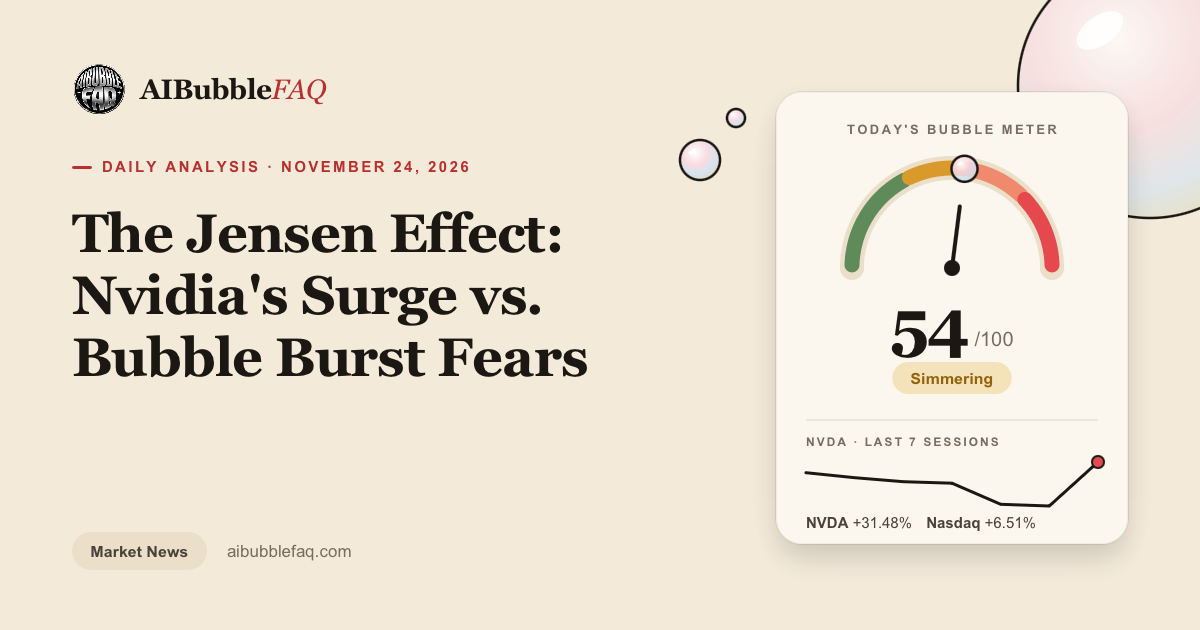
- Our Bubble Meter dropped from a peak of 100 to 54, reflecting a shift from panic to renewed confidence, but also extreme market volatility.
- Underlying the market drama, real-world demand for AI hardware remains intense, even attracting organized cargo thieves.
The Market's Two Minds
The AI stock market is suffering from a severe case of whiplash. Just as the narrative that the “AI bubble has popped” took hold after a brutal market slide, a single piece of news sent shares roaring back, erasing weeks of anxiety in a matter of hours. The unexpected return of co-founder Jensen Huang to the CEO role at Nvidia didn't just lift one company; it challenged the entire bearish thesis that has dominated financial commentary.
Today’s story is one of a fundamental conflict. On one side, you have seasoned economists and mounting evidence of a market correction already in progress. On the other, you have a tidal wave of investor confidence in a single leader, powerful enough to add a trillion dollars of value to a company in a day. This leaves everyday investors and tech workers caught in the middle, trying to figure out if the recent downturn was the beginning of the end or just a bump on the road to further growth.
What Happened Today
The dominant news was the stunning reinstatement of Jensen Huang as Nvidia's CEO. The market's reaction was immediate and explosive. Nvidia's stock soared over 30%, according to Artvoice, a move that NJ.com noted was a clear signal of Wall Street's confidence. The rally was so powerful that it pushed Nvidia's total market value up by $1 trillion to a staggering $4 trillion, as reported by Fortune. This wasn't just an Nvidia story; the surge lifted the entire tech sector, driving up the Dow, S&P 500, and Nasdaq indices, according to EUROPE SAYS.
This euphoria stands in stark contrast to the mood just days ago. A separate Fortune article noted that prominent economists like Paul Krugman had already declared the AI bubble burst. That sentiment was echoed across the media, with USA TODAY asking if the market tumbling was the final pop. The fears had become so widespread that they were rattling global markets, even contributing to a slide in oil prices as doubts grew about AI's near-term economic potential, reports OilPrice.
Even with today's rally, caution remains. One analyst told Seeking Alpha that while Huang's return is a positive, he “can't fix everything,” and a market correction could still be on the table. Meanwhile, a prominent investor cited by Markets Insider is holding to a prediction that Nvidia's stock will eventually crash, highlighting the deep division of opinion.
What Our Data Shows
Our own market data paints a clear picture of this volatility. The week leading up to today was grim. Between November 17 and November 21, the tech-heavy Nasdaq Composite index fell from 24,328 to 22,617. Nvidia, the bellwether for the AI boom, saw its stock price collapse from over $155 to nearly $125 in the same period.
Reflecting this widespread panic, the AIBubbleFAQ Threat Index—what we call our Bubble Meter—surged. After starting the week at a high 95 out of 100, it hit a perfect 100 on November 20, signaling that market conditions displayed the maximum characteristics of a speculative bubble at risk of popping. The fear was palpable.
Then came today, November 24. The trend reversed with incredible force. The Nasdaq jumped back over 24,000, and Nvidia's stock rocketed to $165.05, a new high. In response, our Bubble Meter plummeted from 79 to 54. This dramatic drop doesn't mean the danger is over. Rather, it shows that the panic-selling pressure has been replaced by a powerful wave of buying confidence, driven by a single event. The key takeaway from our data is the sheer velocity of the mood swing, a hallmark of a highly speculative and news-sensitive market.
The Bull Case vs. The Bear Case
It's crucial to understand both sides of the argument right now, as they are both compelling.
The Bull Case: The Foundation Is Solid
Proponents of the AI boom argue that today's rally is proof of deep, underlying confidence. The market's reaction wasn't just hype; it was a multi-trillion-dollar bet on the proven leadership of a key figure in the industry (,). Bulls also point to the disciplined, long-term investments being made by tech giants. According to Business Insider, Amazon's CFO is meticulously managing the company's massive AI spending, focusing on strategic expansion rather than a reckless gold rush. This suggests a sustainable build-out, not a flimsy bubble.
Furthermore, the real-world demand for AI hardware is undeniable. In a sign of just how valuable these components are, FreightWaves reports that organized cargo thieves are now specifically targeting AI chips. When criminals are chasing hardware down dirt roads, it's a gritty indicator of immense value and scarcity. Finally, some analysts believe the recent downturn was a healthy, if spectacular, implosion and that a market bottom may be near, setting the stage for the next phase of growth, per Seeking Alpha.
The Bear Case: A Rally Built on Sand
Skeptics argue that today's rally does nothing to change the fragile fundamentals. The fact that the entire market can swing so violently on news about one executive at one company is, for them, a sign of extreme instability. As Fortune reported, respected economists had already concluded the bubble was bursting based on valuations that seem disconnected from reality ().
This dependence on Nvidia is a huge risk. The bear case is that the entire AI edifice is propped up by one company whose stock is priced for perfection. Dire long-term predictions, like the one for a crash to $27 reported by Markets Insider, may seem extreme, but they highlight a belief that a severe correction is inevitable. The fear is that the recent sell-off wasn't a blip but the first tremor of a much larger earthquake, as broader economic doubts about AI's payoff continue to grow ().
What It Means For You
For Investors
If you hold individual tech stocks, the lesson is clear: volatility is extreme. The market's behavior underscores the risks of concentrating your portfolio in a few hot names. For long-term investors with 401(k)s or index funds, today's rally is a welcome boost, but it's also a stark reminder of how much market-cap-weighted indices like the S&P 500 depend on the fortunes of a handful of mega-cap tech companies. The smart move is to prepare for more turbulence, not to assume the coast is clear.
For People Who Use or Pay for AI
The corporate strategy behind the stock moves tells a more consistent story. Massive, sustained investment from players like Amazon means you can expect AI tools to become more powerful and widespread (). However, the intense demand and high value of the underlying hardware, highlighted by the reports of cargo theft (), create real supply chain risks. This could translate into higher prices or delays for the next generation of AI-powered services and devices.
What to Watch Next
- Enterprise AI Spending Plans: The upcoming earnings reports from Amazon, Microsoft, and Google will be critical. Listen for what their CFOs say about capital expenditure. Are they continuing their multi-billion dollar AI infrastructure build-outs, as the Business Insider report suggests, or are they tapping the brakes?
- Nvidia's Next Strategic Move: With Jensen Huang back, Wall Street will be hanging on his every word. His first major investor call or public appearance will be heavily scrutinized for any shifts in strategy or guidance that could signal the company's direction beyond this initial relief rally ().
- Spillover into Other Markets: Keep an eye on whether AI market sentiment continues to affect unrelated sectors. The OilPrice story was a key example. If AI volatility consistently moves commodity or industrial markets, it suggests the stakes are rising and a potential downturn could have broader economic consequences.
Frequently asked questions
Why did Nvidia's stock price go up so much today?
Nvidia's stock surged after the company announced the unexpected return of its co-founder, Jensen Huang, as CEO. Investors reacted with extreme confidence, seeing his leadership as a massive asset that ensures the company's strategic direction in the competitive AI chip market.
Is the AI stock bubble bursting in 2026?
The signals are very mixed. Before this week's rally, many prominent economists and analysts believed the bubble had popped after a significant market downturn. However, the powerful rebound shows that strong investor confidence can still drive the market higher, leaving the question of a definitive burst unanswered for now.
How does the AI stock market affect my 401(k)?
Many 401(k) plans are invested in index funds like the S&P 500. Because these funds are weighted by market capitalization, a few giant AI-related tech companies like Nvidia make up a significant portion of the index's value. Therefore, extreme swings in these key AI stocks can have a noticeable impact on the performance of your retirement savings.
Sources
- Jensen Is Back, But He Can't Fix Everything — Seeking Alpha
- Paul Krugman, Matt Stoller and Dean Baker say the AI bubble has popped. Wall Street bets on spending — Fortune
- Stocks are tumbling. Has the AI bubble finally burst? — USA TODAY
- Prediction: Nvidia Stock Will Eventually Crash to $27, but ‘Don’t Short It Just Yet,’ Says Investor — Markets Insider
- Wall Street just put a $1 trillion price on Jensen Huang as Nvidia stock soars 31% after his return — Fortune
- Spectacular AI Bubble Implosion Suggests The Bottom May Be Near — Seeking Alpha
- Oil Prices Slide as AI Bubble Fears Rattle Global Markets — OilPrice
- Nvidia stock soars as Jensen Huang returns as CEO — NJ.com
- Cargo Thieves Are Chasing AI Hardware Down the Dirt Road to the Data Center — FreightWaves
- The CFO at the center of Amazon’s AI spending blitz — Business Insider
- Nvidia Stock Soars Over 30% as Board Reinstates Jensen Huang as CEO — Artvoice
- Stock market today: Nvidia stock soars after company reinstates Jensen Huang as CEO; Dow, S&P 500, Nasdaq surge — EUROPE SAYS
- Nvidia stock soars as Jensen Huang returns as CEO — MassLive
This analysis was researched with AI assistance and reviewed by an editor before publication. Market data comes from AIBubbleFAQ's own trackers — see our methodology. It is not financial advice.