
Key takeaways · Threat signal 8/10 (Critical)
- Nvidia is facing simultaneous pressure from bubble warnings, internal leadership issues, and political controversy.
- Prominent investors are signaling plans to bet against the stock, citing extreme overvaluation and market optimism.
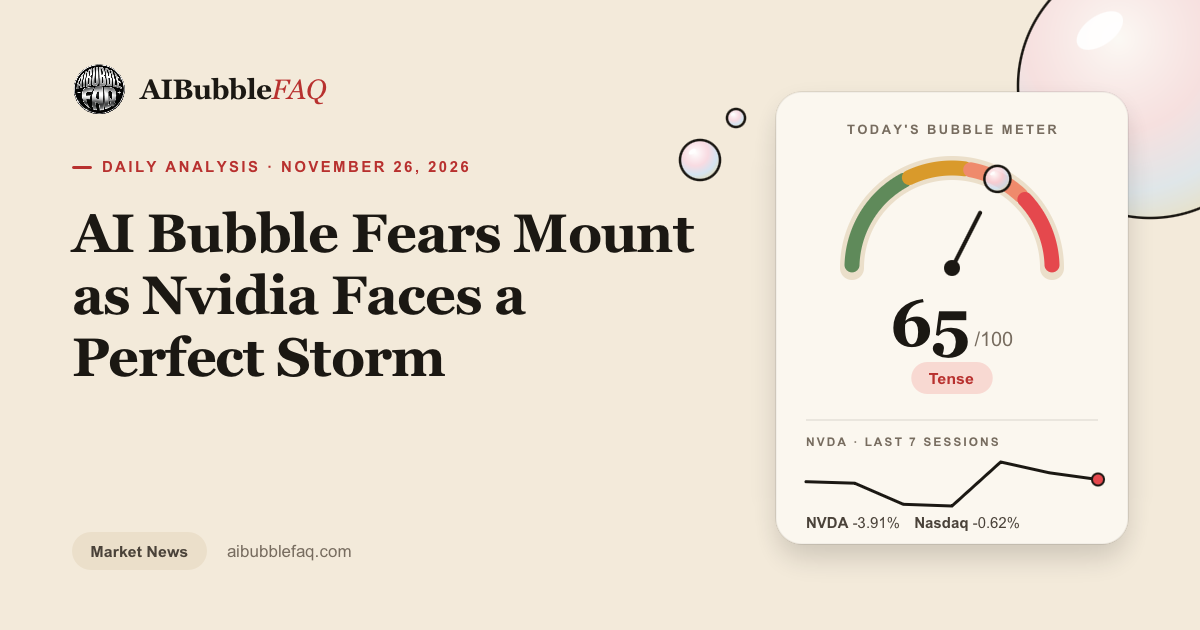
- Our Bubble Meter shows a sharp spike in risk, reflecting the market's reaction to this confluence of negative news.
- Despite the turmoil, some analysts maintain a 'Buy' rating on Nvidia, though they acknowledge significant risks remain.
The Gathering Storm Over AI Stocks
The story of the AI investment boom, long driven by thrilling technological progress and soaring profits, has taken a dark and complex turn. The narrative is no longer just about processing power and earnings reports. Instead, the market’s central player, Nvidia, finds itself at the heart of a perfect storm, battered by simultaneous high winds from three directions: classic bubble warnings from seasoned market watchers, a destabilizing leadership crisis, and an unprecedented level of political entanglement.
This triple threat is testing the very foundations of the AI rally. While the promise of artificial intelligence remains immense, the path for investors has suddenly become fraught with new kinds of risk that have little to do with technology. The question is no longer simply whether AI is overvalued, but whether its leading company can navigate intense scrutiny from Wall Street, its own boardroom, and Washington D.C. all at once. The market’s recent whiplash suggests investors are struggling to price in this chaotic new reality.
Headlines, Headaches, and High Drama
The week’s news flow reads like a script for a market thriller. Fears of a speculative bubble, which have been simmering for months, boiled over as a tech guru explicitly compared Nvidia’s meteoric rise to historical manias like Dutch tulips and Bored Ape NFTs in a Business Insider report. This sentiment was echoed by another heavyweight when the same publication revealed that Michael Burry, of ‘The Big Short’ fame, is actively looking for the right moment of market optimism to bet against Nvidia stock again.
These speculative warnings are grounded in fundamental concerns. An analyst on Seeking Alpha issued a cautious “Hold” rating, pointing to Nvidia’s heavy reliance on what it called “unproven AI infrastructure spending.” The core worry is that customers pouring billions into AI hardware may not see the profits they expect, leading to a future drop-off in demand.
This market anxiety has been amplified by a dramatic leadership crisis. According to Gizmodo, a tumultuous period saw CEO Jensen Huang briefly ousted and then quickly reinstated, a saga that temporarily knocked him from the “Trillion Dollar Man” perch as the company's valuation fluctuated. The internal turmoil deepened when Huang admitted to code-of-conduct violations, a revelation that sent the stock tumbling nearly 6%, as reported by Markets Insider.
Adding a volatile third element to the mix is politics. Multiple CBS News reports and an article in The Washington Post revealed that former President Donald Trump held millions in Nvidia stock while he was reportedly pressing the company to reinstate its CEO. This has raised serious questions about conflicts of interest and political influence over a key market player. While Snopes.com debunked a specific viral claim about the timing and size of Trump's investment, the core story has introduced a new layer of political risk for investors.
What Our Data Shows
The AIBubbleFAQ Bubble Meter, our proprietary threat index, has graphically captured this surge in uncertainty. After hitting a peak fear level of 100 on November 20th, it relaxed significantly to 54 and then 37 as the market rebounded early in the week. However, as news of the CEO’s conduct violation and the political controversy intensified, the meter shot back up to 65 on November 25th.
This jump from 37 to 65 in a single day, even as the stock price didn’t completely collapse, indicates that the *nature* of the risk has changed. The market is now pricing in non-financial threats: governance, ethics, and political unpredictability.
Nvidia’s stock price tells the same story of instability. In the span of a week, it crashed from over $145 to near $125, staged a massive recovery to $165, and then fell back again to finish around $149. This is not the chart of a market calmly assessing fundamentals; it’s the signature of a market reacting violently to a rapid-fire succession of destabilizing headlines.
The Bull Case vs. The Bear Case
The Bull Case
Bulls argue that the current turmoil is just noise distracting from an undeniable technological revolution. They point to the fact that, even amid the chaos, analysts at Raymond James reaffirmed their “Buy” rating on Nvidia with a $350 price target, as noted by Markets Insider. The bull thesis is that the demand for AI chips is a decade-long megatrend, and Nvidia has a commanding lead. They believe the leadership and political issues will eventually be resolved, and the company’s powerful earnings potential will reassert itself. The “overhangs” are real, but they are temporary headwinds in a much larger, long-term growth story.
The Bear Case
Bears, on the other hand, see a house of cards trembling. The trifecta of bubble comparisons from experts, a famed short-seller circling for an entry point, and internal corporate drama is a classic setup for a major correction. They argue the political dimension adds a wildcard that makes the stock un-investable for anyone with a low tolerance for risk. For bears, the value investor’s warning about unproven AI spending is the most critical point: if the AI gold rush doesn't deliver clear profits for Nvidia’s customers, the demand could dry up much faster than bulls expect, revealing the current valuation to be unsustainable.
What It Means For You
For Investors
If you own Nvidia or other high-flying AI stocks directly, prepare for continued volatility. The stock is now a proxy for headlines about everything from CEO conduct to presidential politics. For those with a diversified 401(k) or index funds, you are not immune. Nvidia has become such a large component of the S&P 500 and Nasdaq 100 that its wild swings have an outsized impact on the entire market and your retirement portfolio. This episode is a stark reminder of the concentration risk that has built up in major market indexes.
For AI Users and Developers
In the short term, you are unlikely to see any impact on the performance or availability of the AI tools you use at work. The chips powering today's services are already installed and running. Longer-term, however, instability at the top of the hardware supply chain could have consequences. If market fear and leadership uncertainty cause Nvidia or its customers to pull back on investment, it could slow the pace of innovation. This could eventually affect the cost and accessibility of the massive computing power needed to build and train the next generation of even more powerful AI models.
What to Watch Next
- Nvidia's Board Response: Any official statements or actions from Nvidia's board of directors regarding CEO Jensen Huang's admitted code-of-conduct violations will be critical. Silence could breed more uncertainty, while a decisive response could calm investor nerves.
- Michael Burry's Next Filing: Investors will be closely watching the next 13F filing from Scion Asset Management. If Burry, as he has signaled, discloses a significant short position against Nvidia, it would be a powerful bearish signal to the broader market.
- Further Political Disclosures: The story about political figures investing in key technology companies may have legs. Watch for any follow-up reporting or official inquiries, as this could become a recurring source of market-moving headlines for Nvidia and other tech giants.
Frequently asked questions
Is the AI stock market a bubble like the dot-com era?
Many analysts are drawing parallels, with one comparing Nvidia's stock surge to historical bubbles like Dutch tulips. They point to soaring valuations that seem disconnected from traditional metrics. However, bulls argue that today's AI leaders have massive real revenue and profits, unlike many dot-com firms, though bears question if the current level of customer spending is sustainable.
How can politics affect a tech stock like Nvidia?
When a major political figure like Donald Trump owns millions in stock and is reported to be influencing company leadership, it introduces a high degree of uncertainty. Investors worry about potential conflicts of interest, favoritism, and future regulatory scrutiny, which can make a stock's price more volatile regardless of the company's actual business performance.
I have a 401(k). Should I be worried about Nvidia's stock drop?
While your 401(k) is diversified, you are not completely insulated. Nvidia has become such a large part of major index funds like the S&P 500 that its performance has a noticeable impact on the overall market. Its recent volatility is a major factor in the market's choppiness, affecting your portfolio even if you don't own the stock directly.
Sources
- Nvidia Stock Has Shades of Dutch Tulips, Bored Ape NFTs, Tech Guru Says — Business Insider
- Michael Burry Pinpoints the Next Time He'll Short Nvidia Stock — Business Insider
- Jensen Huang Is No Longer the Trillion Dollar Man — Gizmodo
- Nvidia: A Value Investor's Spin On The World's Largest AI Business — Seeking Alpha
- Trump owned millions in Nvidia stock as he pressed chip giant to reinstate Jensen Huang — CBS News
- Nvidia Stock (NVDA) Drops Nearly 6% as CEO Jensen Huang Admits Code-of-Conduct Violations — Markets Insider
- See all of Trump’s Nvidia stock trades since January — The Washington Post
- Nvidia Stock (NVDA) Forecast: Raymond James Reaffirms Buy Rating but Says “Overhangs Remain” — Markets Insider
- Did Trump invest $3M in Nvidia before it reinstated Jensen Huang? — Snopes.com
This analysis was researched with AI assistance and reviewed by an editor before publication. Market data comes from AIBubbleFAQ's own trackers — see our methodology. It is not financial advice.