
Key takeaways · Threat signal 9/10 (Critical)
- Nvidia's stock fell 20% in one week due to leadership uncertainty, not poor business performance.
- The market's extreme reaction to the CEO's exit and potential return highlights a major 'key person risk' for the AI sector.
- Our Bubble Meter hit its maximum of 100, signaling peak stress before the price correction eased immediate pressure.
- High-profile investments continue, but the incident exposes how fragile the AI rally is to non-financial news.
The Big Picture: A Market Built on One Man?
The AI investment boom has been built on a simple story: soaring demand for powerful computer chips will create unprecedented wealth for the companies that make them. But this week, that narrative was violently shaken. Nvidia, the undisputed king of AI hardware, saw its stock plummet not on bad sales or a competitor’s breakthrough, but on drama in the executive suite. The company’s value swung wildly based on rumors about a single person: its now-former CEO, Jensen Huang.
This episode exposes a critical vulnerability in the AI rally. When a market becomes so dependent on faith in a visionary founder, it’s a classic warning sign of a bubble. The wild price swings suggest that valuations are detached from underlying business fundamentals and are instead propped up by sentiment and hero worship. While the technology is real, the stock prices may be built on something far less stable.
What Happened This Week
The chaos began with news of the “scandal-ridden exit” of Nvidia’s celebrated CEO, Jensen Huang, an event preceded by a flurry of trades in the company’s stock by Donald Trump’s portfolio, as reported by the New York Post. The market, deeply unsettled by the departure of the company’s visionary leader, reacted swiftly and negatively. Nvidia’s stock fell further on speculation that Huang might join chief rival Intel, a possibility floated by Investor's Business Daily.
The market’s hypersensitivity was on full display when, according to Variety, the stock immediately surged after Huang made a public statement saying he’d be “honored” to return. This volatility underscores how much of Nvidia’s valuation has been tied directly to him. Amid the turmoil, disclosures continued to show significant and growing investment in Nvidia by high-profile figures. Reports from U.S. News & World Report and the Buffalo News detailed Donald Trump’s stake growing to as much as $62 million, signaling that some prominent investors retain strong confidence in the AI hardware market. All this drama unfolded as investors nervously await the company’s crucial Q3 earnings report, which Investor's Business Daily notes will be a key indicator for the entire sector.
What Our Data Shows
Our market data paints a clear picture of a sector in distress, with the pain centered on its leader. Over the past week, Nvidia’s stock price collapsed by nearly 20%, falling from $156.14 to $125.53. The broader Nasdaq index also fell, but by a less severe 8%, from around 24,500 to 22,600. This divergence shows the recent sell-off was primarily an Nvidia story, not a general market panic.
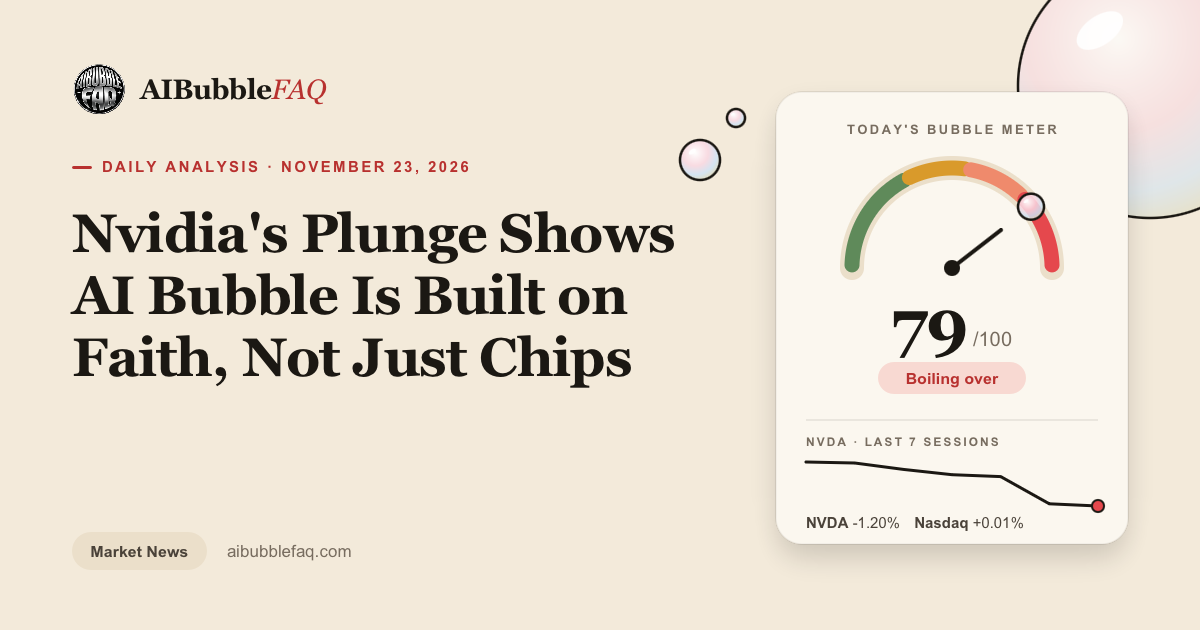
The AIBubbleFAQ Bubble Meter reflects this intense, concentrated stress. On November 20, as the stock was in freefall, our meter hit 100/100, its maximum threat level. This indicates market conditions of extreme froth and panic. Following the sharp price correction, the meter has since fallen to 79. While this is a decrease, a score of 79 still represents a very high-risk environment. The bubble hasn’t popped, but the week’s events have let a significant amount of air out, violently.
The Bull Case vs. The Bear Case
It’s easy to see this week’s news as pure chaos, but there are two very different ways to interpret it.
The Bull Case: A Necessary, Healthy Correction
Bulls argue that this was a healthy, if painful, market reaction. A company is more than its CEO, and the market was right to punish Nvidia for leadership instability and potential governance issues. The underlying demand for its AI chips remains unchanged. The significant investments from figures like Donald Trump show that smart money is still betting on the long-term AI hardware boom. This sell-off creates a buying opportunity for those who believe in the fundamentals, which are expected to be confirmed in the upcoming Q3 earnings report. Once a new, stable leadership is in place—or Huang returns—the stock will rebound, powered by real-world demand.
The Bear Case: The Emperor Has No Clothes
Bears see this as a confirmation of their worst fears. The AI rally was never about fundamentals; it was a speculative frenzy built on a story, and Jensen Huang was the chief storyteller. With him gone, the narrative has collapsed. The stock’s valuation was so inflated that it couldn’t withstand a single point of failure. The “scandal-ridden exit” hints at deeper, undisclosed problems within the company. This price drop isn’t a correction; it’s the beginning of a larger collapse as the market wakes up to the fact that no company is worth this much based on the vision of just one person. If the Q3 earnings show even a hint of weakness, the floodgates could open.
What It Means For You
For Investors
If you hold individual tech stocks like Nvidia, this week was a brutal lesson in volatility and key person risk—the danger of a company being overly reliant on a single individual. For those with diversified investments in index funds or 401(k)s, the impact was felt but cushioned by the broader market. This event serves as a critical reminder that even the most dominant companies carry unique, unpredictable risks. It’s a moment to review your portfolio’s concentration in the AI sector and ensure it aligns with your risk tolerance.
For AI Users and Tech Workers
For now, the drama in Nvidia’s boardroom doesn’t change how ChatGPT or your company’s AI tools work. The chips powering the AI revolution are still running. However, sustained leadership instability at the world’s most important AI hardware supplier could have long-term consequences. It could lead to delays in next-generation chip roadmaps, shifts in corporate strategy, or changes in the pricing and availability of the GPUs your work depends on. What starts as a shareholder problem could eventually become a supply chain and innovation problem for the entire tech industry.
What to Watch Next
- Nvidia's Q3 Earnings Report: This is now the most important event on the calendar. Investors will scrutinize not just the numbers, but the company's forward-looking guidance in a post-Huang era. Will the business fundamentals hold up without its visionary leader at the helm?
- Nvidia's Permanent CEO Announcement: The market is desperate for stability. Who the board chooses as the next CEO—and how quickly they do it—will be a major signal. A return by Huang would likely cause a massive rally, while a prolonged search could create further uncertainty.
- Moves by Intel: The speculation about Huang potentially joining Intel is a major threat to Nvidia. Any announcement or even rumor from Intel regarding its leadership or strategic hiring could dramatically reshape the competitive landscape for AI chips.
Frequently asked questions
Why did Nvidia (NVDA) stock drop so much this week?
Nvidia's stock fell nearly 20% primarily due to the unexpected and reportedly 'scandal-ridden' exit of its longtime CEO, Jensen Huang. The market reacted negatively to the leadership uncertainty, with further drops on speculation he might join a competitor. The fall was driven by sentiment and risk, not by any news about the company's actual sales or products.
What is 'key person risk' for a tech company?
Key person risk is the danger that a company's success is too heavily dependent on a single individual, like a visionary founder or CEO. If that person leaves, becomes ill, or makes a major mistake, it can disproportionately harm the company's stock price, strategy, and morale, as seen with Nvidia this week.
Is the AI stock market in a bubble after this drop?
This week's events are a strong indicator of bubble-like conditions, where valuations are fragile and highly sensitive to news that isn't related to business performance. While the AIBubbleFAQ Bubble Meter has fallen from its peak of 100, it remains at a high level of 79, suggesting that significant risk of a broader correction remains.
Sources
- Nvidia Stock: Will Q3 Report Calm Investors? (Live Coverage) — Investor's Business Daily
- Trump’s portfolio traded Nvidia five times in September — months before CEO’s scandal-ridden exit — New York Post
- Could Jensen Huang Land At Nvidia Rival Intel? — Investor's Business Daily
- Nvidia Stock Up After Huang Says He'd Be 'Honored' to Return as CEO — Variety
- Trump Bought up to $265,000 of Nvidia Stock in September, Disclosure Shows — U.S. News & World Report
- Trump's Nvidia stake grew to as much as $62M, Washington Post reports — Buffalo Buffalo News
This analysis was researched with AI assistance and reviewed by an editor before publication. Market data comes from AIBubbleFAQ's own trackers — see our methodology. It is not financial advice.