
Key takeaways · Threat signal 3/10 (Moderate)
- Jensen Huang's return as Nvidia CEO triggered a massive stock surge, calming immediate market correction fears.
- High-profile figures like Donald Trump and Jim Cramer are signaling confidence in Nvidia, further boosting sentiment.
- Despite the rally, some analysts still advise caution, suggesting the fundamental debate over AI valuations is not over.
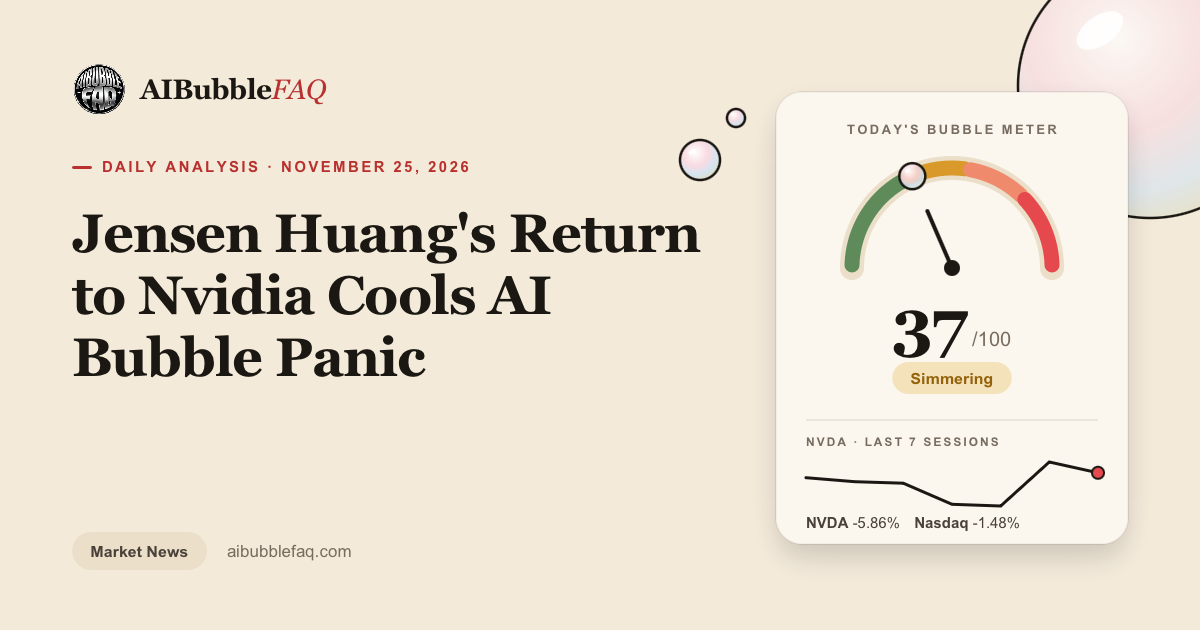
- Our AIBubbleFAQ Bubble Meter has dropped from a peak of 100 to 37, reflecting the sharp reversal in market anxiety.
The Big Picture
Just last week, the drumbeat of an imminent AI bubble burst was deafening. Our own Bubble Meter hit its maximum reading of 100, and investors were bracing for a painful correction. Today, that narrative has been turned on its head. The market has snapped back, and the panic has subsided, driven largely by a single, dramatic event: the return of Jensen Huang as CEO of Nvidia, the undisputed hardware king of the AI boom.
The whiplash in market sentiment reveals just how much of the AI rally is tied not only to technology but to confidence in key leaders. While fundamental questions about sky-high valuations persist, the market has voted with its wallet, signaling that stable, proven leadership at a critical company is enough to override widespread fear—at least for now. The intense debate over whether we're in a bubble hasn't been resolved; it's simply been paused by a personality-driven relief rally.
A Founder's Return Roils the Market
The week's defining story was the whiplash recovery in tech stocks, centered on one company. Nvidia's stock surged over 26% after the unexpected news that its co-founder Jensen Huang was returning as CEO, as reported by cleveland.com and M Live Michigan. The move was seen as a powerful positive catalyst, restoring investor confidence in the chipmaker's leadership and future growth, according to CNBC. The rally wasn't confined to Nvidia; the broader tech market, including Tesla and SpaceX, also snapped back, with Huang's return cited as a key factor by Investor's Business Daily.
This renewed confidence was bolstered by other signals. Prominent market commentator Jim Cramer predicted Nvidia's stock would not return to its recent lows of around $215 anytime soon, despite the recent 31% surge, reports Markets Insider. Adding a political dimension, news that former President Trump owned at least $12 million in Nvidia stock at the end of 2025 signaled high-profile faith in the company, according to KABC-TV. Business Insider even noted that a "Trump intervention" helped bolster the stock's surge. Further calming nerves, Investor's Business Daily reported that the CEO of chip designer Arm was not interested in the Nvidia job, removing a potential source of leadership uncertainty.
However, not everyone is joining the celebration. The Los Angeles Times highlights that general fears of a bubble persist amid the market's volatility. Some analysts are advising investors to look past speculative tech stocks toward high-yield dividend payers as a defensive move for a potential correction, per Seeking Alpha. This caution is exemplified by high-profile tech investor Cathie Wood, whose ARK Invest funds sold Nvidia shares and missed the recent rebound, choosing instead to diversify into private AI and space tech, a strategy detailed by Investor's Business Daily. Meanwhile, the New York Post suggests investors should remain skeptical of the popular "AI bubble" narrative and look for contrarian indicators rather than following the herd.
Our Bubble Meter Plummets
Our own data vividly illustrates the market's sharp reversal. The AIBubbleFAQ Threat Index—what we call the Bubble Meter—is designed to measure market stress and correction risk. On November 20, as the Nasdaq fell to 22,614 and Nvidia's stock hit $127, our Bubble Meter peaked at a perfect 100/100. The panic was palpable.
Following the news of Huang's return, the turnaround was immediate and stark. By November 24, the Nasdaq had climbed back above 24,000 and Nvidia soared to $165.05. In response, our Bubble Meter plummeted to 54/100. As of the latest data from November 25, with Nvidia settling at a still-strong $155.38, the Bubble Meter has fallen even further to just 37/100. This 63-point drop in just a few days is one of the most dramatic declines we've ever recorded, showing just how quickly a single piece of news can extinguish a market fire.
The Bull vs. Bear Debate: Leadership or Overvaluation?
The Bull Case
Bulls argue this week proves that leadership is paramount. The market wasn't just selling off tech; it was pricing in the risk of a leaderless Nvidia, the sector's most crucial company. Jensen Huang's return isn't just symbolic; it restores confidence in the execution, vision, and roadmap that made Nvidia dominant. With leadership uncertainty gone, the stock is simply returning to a valuation that reflects its strategic importance. The confidence from major figures and the market's broad-based rally demonstrate that the fundamental demand for AI infrastructure is robust and the recent dip was a head-fake, not the beginning of the end.
The Bear Case
Bears contend that the market's euphoria is dangerously misplaced. This rally is driven by emotion and the cult of personality, not by a change in the underlying financial realities. The fundamental problems—stratospheric valuations and persistent bubble fears—haven't vanished. A single CEO can't change a company's price-to-earnings ratio overnight. Bears see this as a classic 'bull trap,' a temporary surge that lures in optimistic investors before the real correction hits. They would point to cautionary advice to rotate into safer, high-yield assets and highlight that even prominent tech bulls like Cathie Wood are diversifying away from the biggest names, suggesting the smart money remains wary.
What This Means for Your Portfolio and Your Work
For Investors
If you're invested in individual tech stocks, this week was a masterclass in volatility and 'key person risk.' The fortunes of a multi-hundred-billion-dollar company turned on a dime based on one personnel announcement. For those with 401(k)s or index funds, it's a stark reminder of how much the overall market's performance (like the S&P 500 and Nasdaq) depends on a handful of mega-cap tech stocks like Nvidia. The core question for your strategy remains: do you ride the renewed momentum, or do you take this as a warning signal to rebalance into more diversified or defensive assets, as some analysts suggest?
For AI Users and Developers
For anyone building, buying, or using AI tools, the renewed stability at Nvidia is unequivocally good news in the short term. A crisis or leadership vacuum at the company that produces the vast majority of AI training chips could have created massive disruptions in the hardware supply chain, delaying projects and driving up costs. Huang's return signals continuity for the hardware and, just as importantly, the CUDA software ecosystem that powers most of the AI world. This rally solidifies Nvidia's market dominance, ensuring the de facto standard for AI development remains stable for the foreseeable future.
What to Watch Next
- Nvidia's next strategic update: With Jensen Huang back at the helm, his first major presentation or earnings call will be scrutinized intensely. Investors will be listening for any changes to the company's product roadmap, financial forecasts, or competitive strategy to justify the renewed confidence.
- Profit-taking vs. sustained rally: Was this a one-time relief rally or the start of a new leg up? Watch whether the Nasdaq and other key AI stocks hold their gains in the coming weeks or if investors begin to sell and take profits, which would signal a return to the caution we saw last week.
- Institutional investor filings: Keep an eye on the next round of 13F filings from major asset managers like ARK Invest. Will Cathie Wood and other big players reverse course and buy back into Nvidia after missing this surge, or will they double down on their diversification strategies? Their actions will reveal where big money truly believes the market is headed.
Frequently asked questions
Why did Nvidia stock go up so much recently?
Nvidia's stock surged over 26% following the unexpected news that its co-founder, Jensen Huang, was returning to the company as CEO. The market reacted very positively, seeing his return as a sign of strong, stable leadership for the world's most important AI chipmaker.
Is the AI bubble bursting?
Just a week ago, fears of a bursting bubble were at an all-time high. However, the recent market rally, led by Nvidia, has significantly cooled those fears for now. While some analysts remain cautious about high valuations, the immediate panic has subsided.
What does Jensen Huang's return mean for Nvidia?
His return is seen as a major positive catalyst that restores investor confidence in the company's long-term vision and ability to execute its strategy. It removes uncertainty about leadership and reinforces the belief that Nvidia will continue its dominance in the AI hardware market.
Sources
- As the stock market rallies, fears of a bubble persist — Los Angeles Times
- 2 High-Yield Champions To Hold Through The AI Bubble Burst — Seeking Alpha
- Trump owned at least $12 million in Nvidia stock at the end of last year — KABC-TV
- Prediction: Jim Cramer Says Nvidia Stock Isn’t Going Back to $215 Anytime Soon — Markets Insider
- How to think about the ‘AI bubble’ that supposedly threatens the stock market — New York Post
- How Did Cathie Wood Play The Market Crash And Snapback? — Investor's Business Daily
- Nvidia Stock Surge After Trump Intervention Shows Growing Market Role — Business Insider
- Nvidia stock has more upside with Jensen Huang — CNBC
- Dow Jones Futures: Tech Stocks, Nvidia Snap Back On Jensen Huang's Return; Elon Musk-Led SpaceX, Tesla Rally — Investor's Business Daily
- Nvidia stock soars as Jensen Huang returns as CEO — cleveland.com
- Nvidia stock soars as Jensen Huang returns as CEO — M Live Michigan
- Arm Chief Not Interested In Nvidia CEO Job — Investor's Business Daily
This analysis was researched with AI assistance and reviewed by an editor before publication. Market data comes from AIBubbleFAQ's own trackers — see our methodology. It is not financial advice.