
Key takeaways · Threat signal 8/10 (Critical)
- The US midterm elections have introduced significant political uncertainty for the AI sector, rattling investors.
- Concerns are focused on the future of AI infrastructure spending and the stability of hardware supply chains.
- This new political risk is amplifying an existing Wall Street debate about whether AI stock valuations constitute a bubble.
- Key tech stocks like Nvidia have seen sharp declines this week, reflecting heightened market anxiety.
The Big Picture: A Political Chill Hits the AI Boom
The AI market is confronting a harsh new reality this week. After months of soaring valuations driven by technological breakthroughs, the sector is now grappling with a more traditional and unpredictable force: political uncertainty. The aftermath of the U.S. midterm elections has sent a shockwave through the market, raising fundamental questions about the physical infrastructure—the chips, the power, the data centers—that underpins the entire AI revolution. This isn't just another bout of market jitters; it's a direct challenge to the growth story that has justified sky-high stock prices.
This political anxiety is pouring gasoline on a fire that was already smoldering. As reported by Business Insider, top financial minds were already openly debating the existence of an AI bubble at major industry conferences. Now, with tangible risks to supply chains and capital investment on the horizon, that debate has moved from theoretical to immediate. The sharp drop in bellwether stocks and the spike in our own Bubble Meter suggest investors are rapidly repricing AI's future, factoring in a level of risk that wasn't on their radar just a week ago.
What Happened: From Bubble Talk to Market Tremors
The conversation around an AI bubble has been escalating for some time. At the recent SALT London conference, leading financial figures were actively scrutinizing tech valuations and the sustainability of the current boom, signaling a shift in institutional sentiment. But this week, that sentiment met a political catalyst. The U.S. midterm election results have introduced significant unpredictability, with a Tom's Guide report speculating that the outcome could directly impact hardware supply chains and sour investor confidence.
The core of the anxiety lies in the massive physical build-out required to power AI's growth. An analysis in Seeking Alpha suggests the industry is facing a major "post-election rethink" on AI infrastructure and data centers. The piece points to a trifecta of risks—new policies, constraints on power grids, and supply chain vulnerabilities—that could significantly slow down the deployment of capital into these critical projects through 2030. When the primary concern becomes whether companies can even build the foundation for future growth, investor confidence in that growth naturally falters.
What Our Data Shows: The Bubble Meter Spikes
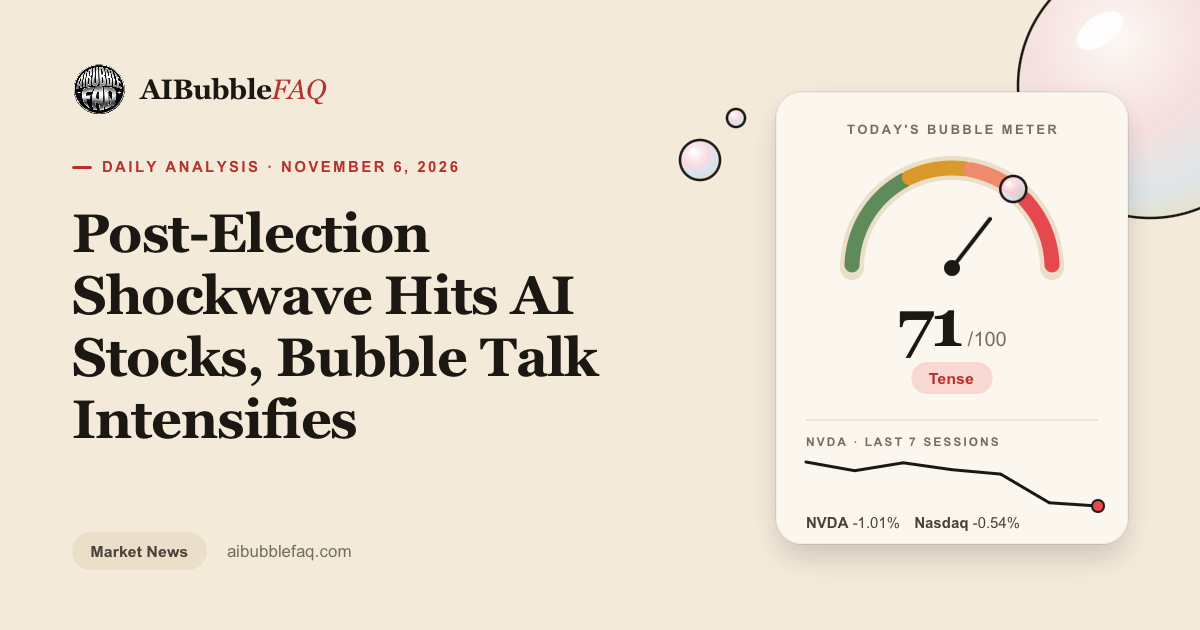
Our market data paints a clear picture of a market in distress. The AIBubbleFAQ Threat Index, which our readers know as the Bubble Meter, reacted violently to the election news. On November 2nd, it stood at a relatively calm 46/100. By the end of trading on November 3rd, as election results rolled in, it had skyrocketed to 86/100, signaling extreme market stress.
While the meter saw a brief dip to 55 on November 4th, it has since resumed its climb, hitting 71/100 today. This isn't a fleeting panic; it's persistent anxiety. The broader market and key AI stocks reflect this trend. The Nasdaq Composite has shed over 1,300 points since its peak on November 2nd, falling from 25,618.51 to today's 24,315.00. Nvidia (NVDA), the chipmaker at the heart of the AI boom, has been hit particularly hard. The stock has plummeted from $207.13 to $181.60 in the same period—a painful drop of over 12% in just four trading days. This is the kind of sharp correction that happens when a foundational assumption about an industry's growth is suddenly called into question.
The Bull Case vs. The Bear Case
The Bull Case: Quality Will Endure
Even amidst the turmoil, the argument for AI's long-term value remains strong. Bulls contend that the technological shift is real and transformative, and that political headwinds, while disruptive, are ultimately temporary. The core demand for AI-powered productivity from businesses and consumers isn't going away. In this view, market downturns are opportunities to invest in high-quality companies with durable business models. A Seeking Alpha analysis makes this case for Microsoft, arguing the company's powerful position in enterprise software and consistent revenue growth make it a winner "even if the AI bubble pops." The argument is that established giants with diverse income streams are insulated from the speculative froth and will continue to thrive by integrating AI into products customers already pay for.
The Bear Case: The Foundation is Cracking
Bears argue that the foundation of the AI boom—limitless capital funding a massive hardware build-out—is now genuinely at risk. Valuations were already stretched to perfection, and this new layer of political uncertainty is an unwelcome dose of reality. The fact that top investors are openly debating a bubble, as Business Insider reported, shows the professional money is nervous. The potential for a slowdown in infrastructure spending is a direct threat to the revenue forecasts of chipmakers, data center operators, and the entire AI ecosystem. The market's sharp sell-off, particularly in bellwethers like Nvidia, isn't just sentiment; it's a rational reaction to a tangible threat to future growth.
What It Means For You
For Investors
If you hold broad market index funds in your 401(k) or brokerage account, you are exposed to this volatility. The tech sector, especially AI-related stocks, has driven a large portion of market gains, and its downturn will weigh on your portfolio. This week is a stark reminder of the risks that come with high growth. For those holding individual tech stocks, the market is beginning to differentiate between the speculative players and established companies with strong fundamentals. As one analysis noted regarding Microsoft, companies with robust, existing platforms may offer a safer harbor than those purely reliant on the continuation of the AI investment boom.
For AI Users and Developers
For now, the AI tools you use at work or home won't change. However, the issues bubbling to the surface could have long-term consequences. A slowdown in data center construction, as warned by Seeking Alpha, could eventually lead to higher costs for cloud computing and API access. It might also mean longer waits for the next generation of powerful AI models. For tech workers and developers, a sustained market downturn could translate into a tougher job market, hiring freezes, and a more challenging environment for startups seeking funding as venture capital becomes more cautious.
What to Watch Next
- Concrete Policy Signals: The current anxiety is driven by uncertainty. Watch for any specific statements or legislative proposals from newly elected officials regarding semiconductor supply chains, tech tariffs, or energy policy for data centers. Clarity, whether positive or negative, will move the market.
- Big Tech Capital Expenditure (CapEx) Plans: In their upcoming quarterly earnings reports, listen closely to what executives from Microsoft, Amazon, Google, and Meta say about their spending plans for AI infrastructure. Any downward revision to their CapEx forecasts would be a major red flag that the infrastructure slowdown has begun.
- Investor Conference Tone: The SALT London debate was a key indicator of shifting sentiment. Pay attention to the language used at upcoming major tech and finance conferences. If talk of an "AI bubble" moves from a contrarian view to the consensus opinion, it could signal further selling pressure ahead. Stay upto date with AIBubbleFAQ
Frequently asked questions
Why did AI stocks drop after the US midterm elections?
The election results created significant uncertainty about future government policies affecting the tech sector. Investors are specifically concerned about potential disruptions to hardware supply chains and new regulations or costs related to building and powering the massive data centers AI requires.
Is the AI bubble finally popping?
It's too early to declare it popped, but the market is showing serious signs of stress and a major correction is underway. Top investors are now openly debating the bubble thesis, and the sharp, widespread drop in key AI stocks suggests many are selling first and asking questions later.
Should I sell my Nvidia stock after its recent fall?
AIBubbleFAQ.com does not provide financial advice. Nvidia is central to the AI hardware boom, which makes its stock sensitive to news about the industry's future. The recent drop reflects broad market fears about political risk and high valuations, so any investment decision should be based on your personal financial goals and tolerance for risk.
Sources
- SALT London Speakers Discussed AI Bubble, Elon Musk, Jobs Outlook — Business Insider
- Sam Altman just renamed himself ‘Ram Altman’ in U.S. Midterms aftermath - the panic is setting in, but is the AI bubble starting to crack? — Tom's Guide
- Microsoft Wins Even If The AI Bubble Pops — Seeking Alpha
- Post-Election AI Infrastructure And Data Center Rethink — Seeking Alpha
This analysis was researched with AI assistance and reviewed by an editor before publication. Market data comes from AIBubbleFAQ's own trackers — see our methodology. It is not financial advice.