
Key takeaways · Threat signal 6/10 (Elevated)
- AI hardware demand remains incredibly strong, with Nvidia and AMD landing major deals that are lifting their stock prices.
- Major cloud providers like Google are showing signs of financial strain from massive AI spending combined with weakening customer demand.
- The market is entering a 'prove it' phase where profitability, not just potential, is becoming critical, with upcoming IPOs like Anthropic's serving as a key test.
- Our AIBubbleFAQ Bubble Meter jumped 10 points, reflecting the growing uncertainty and split between booming hardware sales and software-side financial stress.
The Great Divide in AI Investing
The AI market is starting to show a split personality. On one side, the companies building the foundational hardware—the specialized chips that power AI—are seeing demand that continues to defy expectations. On the other, the first cracks are appearing for the companies deploying that hardware, with signs that massive spending isn't yet translating into the expected profits. This creates a confusing picture for investors and tech workers alike: is the boom continuing, or is a correction brewing?
This isn't a simple bull versus bear story anymore. It's a tale of two markets. The first is the 'picks and shovels' market for hardware, which remains white-hot. The second is the application and cloud services market, where the financial reality of turning massive capital investment into profit is proving difficult, even for the world's biggest tech companies. As we head into the end of the year, the market is entering a 'prove it' phase, where fundamentals will start to matter more than hype.
Hardware Soars While Software Gets Scrutinized
The demand for AI infrastructure is undeniable. This week, Investor's Business Daily reported that major deals between Meta Platforms and chipmakers Nvidia and AMD are signaling robust enterprise demand. This isn't just talk; it's billions of dollars being spent to build out the next generation of AI services, which sent both chip stocks higher. The demand is so strong that one Seeking Alpha analysis suggests Nvidia may raise its already staggering 70% growth forecast in November, thanks to easing supply constraints and a tidal wave of orders.
Nvidia is also playing the long game. The company is pursuing a 'vertically integrated' strategy, aiming to control more of the AI stack from chips to software, a move designed to lock in revenue for years to come. However, another Seeking Alpha report notes that this strategy comes with significant execution risk, leading to a cautious 'hold' recommendation despite the positive demand signals.
But while the chipmakers celebrate, there are signs of trouble higher up the value chain. A separate Seeking Alpha analysis flags significant financial risks at Alphabet (Google's parent company). The report points to the company's huge AI capital expenditure—money spent on things like Nvidia's chips—combined with weak cloud demand and fading cash flow. This is a classic warning sign: the costs of AI are concrete and massive, while the returns are still speculative. This development was flagged with a high 9/10 stress signal, suggesting it could be a catalyst for a broader market correction.
The software and services side of AI is also facing a moment of truth. According to NPR, the upcoming Initial Public Offering (IPO) for Anthropic, a major AI model developer, will provide a critical look at the market's true financial health. Its S-1 filing—a document companies file before an IPO that details their financials—will be scrutinized by investors looking for proof of a sustainable business model. The same report also highlights a growing storm cloud on the horizon: regulatory challenges. The rise of AI agents that can read private messages poses an existential threat to user privacy and encryption, which could trigger government intervention and damage user trust.
What Our Data Shows
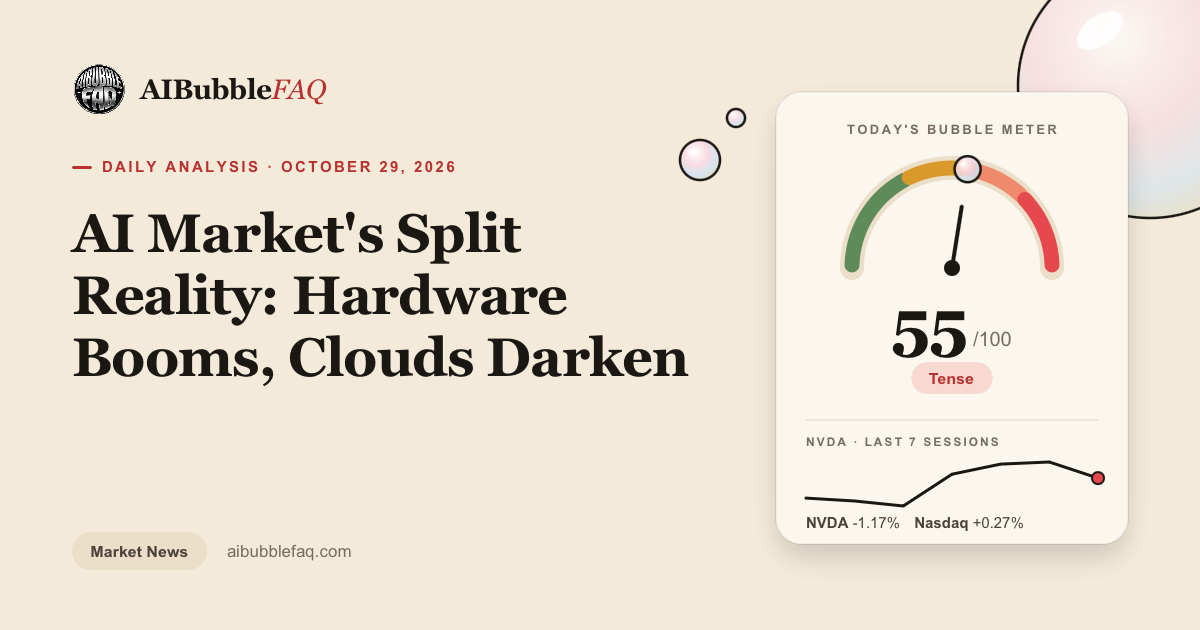
Our own AIBubbleFAQ Threat Index—what we call the Bubble Meter—is reflecting this growing tension. Yesterday, the index jumped 10 points from 45 to 55 out of 100. This is a significant increase in a single day, moving us firmly back into the 'elevated risk' territory. The meter is designed to capture exactly this kind of divergence: while the Nasdaq continues to climb, closing at 26,549.85, the underlying stress signals are flashing yellow.
Interestingly, Nvidia's stock (NVDA) fell slightly yesterday to $215.38, despite a week of mostly positive news. This could indicate that investors are starting to weigh the incredible demand against the broader ecosystem risks, like the slowdown at a major customer like Google. The market is no longer moving as a single, AI-fueled monolith. Instead, it's beginning to differentiate between the clear winners and those with a more challenging path to profitability.
The Bull Case vs. The Bear Case
It's helpful to lay out both sides of the argument honestly.
The Bull Case
Bulls argue that the demand is real, structural, and just getting started. The deals with Meta are not speculative; they are part of a multi-year infrastructure build-out that is essential for competing in the next decade of technology, as reported by Investor's Business Daily. An analyst at Seeking Alpha believes Nvidia's growth could accelerate even further. This isn't a bubble based on flimsy business plans; it's a foundational technology shift on par with the internet or the smartphone. The current spending is an investment that will pay off for decades, and the companies providing the essential tools, like Nvidia, are in an incredibly powerful position.
The Bear Case
Bears look at the same spending and see an unsustainable cash burn. The warning signs at Alphabet, a trillion-dollar company struggling with the math of AI investment versus cloud revenue, are a major red flag for the entire industry, according to Seeking Alpha. The whole ecosystem is predicated on the idea that this infrastructure will eventually generate enormous profits, but the evidence for that is still weak. The upcoming Anthropic IPO, as NPR notes, will force the market to confront the actual balance sheets of a pure-play AI company. Add in future regulatory battles over privacy, and you have a recipe for a significant market correction.
What It Means For You
For Investors
If you're an investor, including those with 401(k)s in broad index funds, this split market complicates things. The era of 'buy any stock with AI in the description' is likely over. The divergence between hardware and software means a Nasdaq index fund holds both the high-flying chipmakers and the companies like Alphabet that are showing strain. This underscores the value of diversification. The performance of individual companies will likely depend more on their specific path to profitability, not just their association with AI.
For AI Users and Developers
If you use or build with AI, the hardware boom is great news. It means more powerful and accessible models are on the way. However, the financial pressures on cloud providers could have direct consequences. Companies may start charging more for API access, cutting back on free tiers, or prioritizing large enterprise customers. For developers, the privacy and regulatory concerns around AI agents mentioned by NPR are a critical issue. Building products that rely on accessing user data will invite intense scrutiny, and the rules of the road could change quickly.
What to Watch Next
- Nvidia's November Earnings Call: The key question will be whether the company raises its 70% growth guidance, as one analyst predicts. This will be the most direct signal of whether the hardware boom has even more room to run.
- Anthropic's IPO Pricing: The S-1 filing is just the beginning. How Wall Street prices the IPO and how the stock performs on its first day of trading will be a major referendum on the entire AI software sector.
- Earnings from Amazon and Microsoft: We need to see if their cloud divisions (AWS and Azure) report the same weak demand that is reportedly plaguing Google Cloud. If they do, it's an industry-wide problem. If not, Google's issues may be its own. Keep updated with aibubble faq.
Frequently asked questions
Is the AI stock bubble popping?
It's not popping, but it is showing signs of stress and splitting into two distinct markets. Hardware stocks like Nvidia remain very strong due to high demand, but there are warning signs in the cloud and software sectors where massive spending has yet to translate into clear profits.
Should I sell my Nvidia stock?
We do not provide financial advice on specific stocks. Analyst sentiment on Nvidia is currently mixed; while some see its incredible growth continuing due to overwhelming demand, others issue a 'hold' rating, citing risks related to its long-term strategy and the high expectations already priced into the stock.
What does Alphabet's weak cloud growth mean for the AI industry?
It's a significant warning sign. It suggests that even for one of the world's largest tech companies, the enormous cost of AI infrastructure is not yet being offset by customer revenue. If this trend continues, it could signal a broader problem for the industry: the path to making AI profitable may be much harder than investors currently believe.
Sources
- Alphabet Earnings To Accelerate The AI Bubble Burst — Seeking Alpha
- Inside Anthropic’s IPO + How AI Agents Spy on Your Messages — NPR
- Nvidia Stock: Berlin Keynote Signals A More Vertically Integrated Future (NASDAQ:NVDA) — Seeking Alpha
- Nvidia Stock May Actually Raise Its 70% Growth Guide In November (NASDAQ:NVDA) — Seeking Alpha
- Nvidia Stock, AMD Rise On Meta Muse Deals — Investor's Business Daily
This analysis was researched with AI assistance and reviewed by an editor before publication. Market data comes from AIBubbleFAQ's own trackers — see our methodology. It is not financial advice.