
Key takeaways · Threat signal 9/10 (Critical)
- Financial analysts are increasingly warning of an imminent AI market correction, with some comparing it to the dot-com crash.
- Negative cash flow from AI investments and distress at key infrastructure firms signal that the spending boom may be unsustainable.
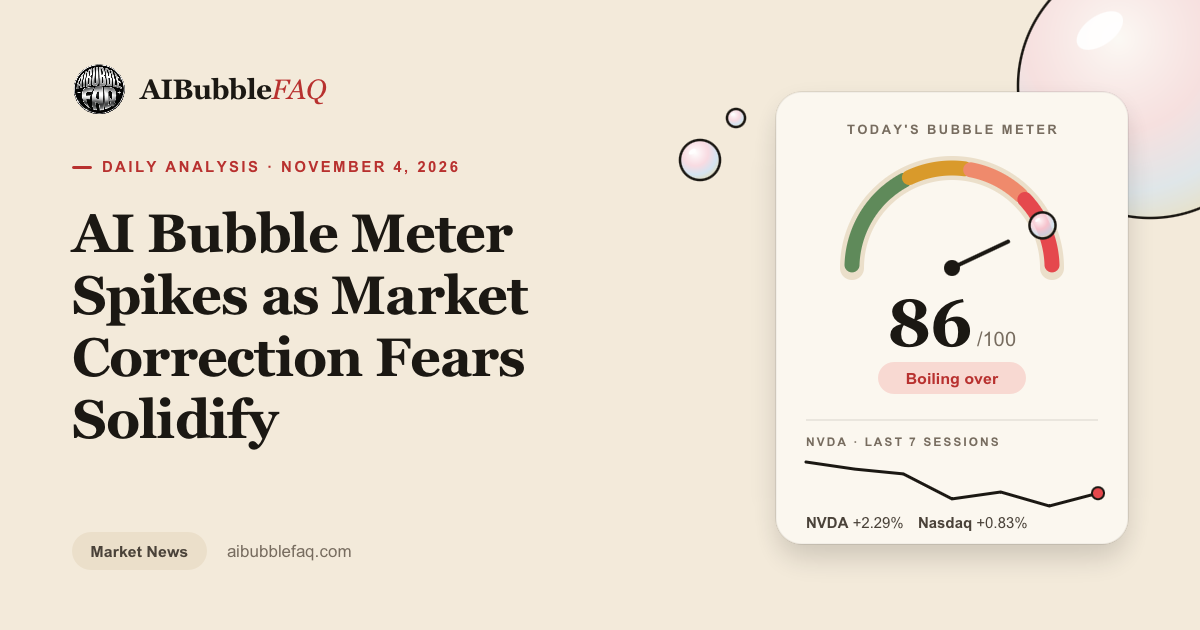
- Our AIBubbleFAQ Bubble Meter surged to 86/100, reflecting a sharp increase in market stress and validating widespread concerns.
- Despite the warnings, tech giants continue to pour billions into AI infrastructure, betting on long-term, foundational growth.
Bubble Fears Solidify as Market Signals Turn Red
The conversation around the AI investment boom has taken a sharp, anxious turn. For months, the debate has been whether the soaring valuations of AI-related companies constituted a bubble. Now, a growing chorus of market watchers suggests the more pressing question is when, not if, that bubble will burst. This shift from theoretical debate to active preparation is being driven by concrete financial signals that the AI gold rush may have run ahead of reality.
A wave of analysis from financial publications points to an impending market correction, with some even drawing parallels to the dot-com crash. These warnings are not just based on sentiment; they are rooted in troubling financial data. Reports indicate that the massive capital spending on AI infrastructure is leading to “accelerating negative free cash flow” for the cloud giants, or hyperscalers, who form the backbone of the AI economy. At the same time, specific companies in the ecosystem are showing signs of “distress,” suggesting a potential shakeout is on the horizon.
This surge in anxiety is starkly reflected in our own data. The AIBubbleFAQ Bubble Meter, which tracks market stress signals, has spiked to its highest level in recent memory. The narrative and the numbers are telling the same story: after a year of unchecked enthusiasm, the AI market is facing a serious test of its foundation.
A Chorus of Correction Warnings
The warnings this week are widespread and specific. Financial professionals are now actively advising tech investors on how to prepare their portfolios for a potential bubble burst, according to Business Insider. One analysis from Seeking Alpha declared that the “AI bubble ran into reality last week,” pointing to the unsustainable cash burn from hyperscalers as a primary catalyst for a correction. The sentiment, as described by SiliconANGLE News, is that the bubble is “letting out some air.”
This discussion has become so mainstream that Tom's Guide polled leading AI models themselves on the topic, with one making a direct comparison to the dot-com crash—a historical event where revolutionary technology was real but initial market valuations were not.
Beyond the general market mood, specific financial cracks are appearing. The negative cash flow from AI investments is a major red flag, as it directly impacts tech company valuations and could limit future funding for developers, per Seeking Alpha. We are also seeing signs of trouble at individual firms. Investor's Business Daily highlights the stock distress at CoreWeave, a critical GPU cloud provider, as a sign of “potential vulnerabilities” that could signal a wider market shakeout. Even Nvidia, the undisputed market leader, is not immune. The same publication reports that Nvidia’s stock is flashing “sell signals” and has fallen below its 200-day moving average—a key technical indicator of market health—just as its crucial Q3 earnings report looms.
Our Bubble Meter Sounds the Alarm
The qualitative warnings from the market are powerfully validated by our quantitative data. After hovering in a moderate-to-high range of 44 to 65 last week, our AIBubbleFAQ Bubble Meter spiked dramatically on November 3rd, hitting 80 and then closing the day at 86 out of 100.
This is not a minor fluctuation. A jump of this magnitude indicates a rapid and significant increase in perceived market risk. The Bubble Meter is designed to synthesize a wide range of stress signals, and this week, nearly all of them turned red simultaneously. The high volume of bearish reports, combined with negative technical indicators for bellwether stocks, created a perfect storm that sent the index soaring into the high-danger zone.
This spike coincided with significant market volatility. While the Nasdaq saw a small bounce to close at 25,372.01 on November 3rd, it remains substantially down from its perch above 26,400 on October 27th. Nvidia (NVDA), the poster child for the AI boom, has followed a similar downward trajectory. The stock fell from nearly $218 to close at $206.69 over the same period, reflecting the growing investor caution detailed across the financial press.
The Bull and Bear Arguments
The Bear Case
The bears argue that the reckoning has begun. The core of their argument is that valuations have become detached from financial reality. The massive spending on AI chips and data centers has yet to produce proportional profits or positive cash flow, as Seeking Alpha noted. Signs of distress at a key infrastructure player like CoreWeave suggest the ecosystem is more fragile than it appears (Investor's Business Daily). When the market leader, Nvidia, flashes sell signals, it’s a sign that the entire sector could be headed for a fall (Investor's Business Daily). The comparison to the dot-com crash is potent: the internet was transformative, but most of the initial dot-com companies went bankrupt. The same could be true for AI.
The Bull Case
The bulls, however, urge calm, arguing that investors shouldn't be “swayed by AI bubble burst doomerism,” in the words of one Seeking Alpha columnist. Their case rests on the sheer commitment of Big Tech. Microsoft, Amazon, Google, and Meta are not speculative startups; they are some of the most profitable companies in history. Their decision to “aggressively invest in AI infrastructure” is a long-term strategic imperative, not a short-term gamble. This sustained investment, the bulls argue, signals confidence in “continued sector growth and potential for sustained returns.” From this perspective, the current downturn is simply market volatility along the path of a fundamental technological shift, shaking out weaker players while the giants lay the foundation for decades of growth.
What This Means for Your Portfolio and Your Work
For Investors
For 401(k) and Index Fund Investors: Your portfolio is diversified, but the outsized growth of the tech sector means an AI correction could still pull down major indexes like the Nasdaq and S&P 500. This is a moment to review your risk tolerance and ensure your asset allocation aligns with your long-term goals. The guidance from financial professionals is to prepare for volatility, not to panic sell into it (Business Insider).
For Active Tech Stock Investors: The risk level has clearly increased. Nvidia's sell signals and CoreWeave's distress are canaries in the coal mine (Investor's Business Daily, Investor's Business Daily). A market correction could bring lower entry points, but trying to time the bottom is notoriously difficult. Caution is warranted, as today's high-flyers could see significant declines if sentiment continues to sour.
For AI Users and Developers
For People Using AI at Work: The underlying technology is here to stay. However, a market downturn could impact the ecosystem of tools you use. Expect some smaller, cash-burning startups to be acquired or to shut down. The pace of innovation may slow temporarily as companies focus more on profitability than on growth at all costs.
For Developers and Tech Workers: As Seeking Alpha notes, a market correction directly impacts “developers' future funding.” Venture capital will likely become more selective, and corporate budgets could tighten. The “shakeout” mentioned by Investor's Business Daily suggests industry consolidation, which could mean fewer startups hiring but potentially more stability at the companies that survive. Job security may be highest at the large, well-capitalized tech giants.
What to Watch For
- Nvidia's Q3 Earnings: With the stock already showing technical weakness, its upcoming earnings report is a critical test. Investors will scrutinize not just the results but, more importantly, the company's forward-looking guidance for signs of slowing demand (Investor's Business Daily).
- Hyperscaler Cash Flow: Pay close attention to the next earnings reports from Microsoft, Amazon, and Google. Specifically, look at their free cash flow and commentary on capital expenditures. Are they pulling back on AI spending to preserve cash, or are they pushing forward despite the burn? (Seeking Alpha).
- News on CoreWeave: As a key private company in the AI infrastructure space, any further news regarding CoreWeave's financial “distress”—be it a new funding round, a restructuring, or major customer news—will serve as a barometer for the health of the broader AI hardware ecosystem (Investor's Business Daily).
Frequently asked questions
Is the AI stock market a bubble?
There is a growing consensus among market analysts that AI stock valuations have become stretched, creating bubble-like conditions. While the underlying technology is transformative, concerns are rising that stock prices have outpaced actual profits, leading to a high risk of a market correction.
What happens to my 401(k) if the AI bubble bursts?
If you have a diversified 401(k), it likely holds major index funds. Since AI-related tech stocks make up a large portion of indexes like the S&P 500 and Nasdaq, a burst could cause your overall balance to decline. However, diversification means other sectors may cushion the blow, and long-term retirement plans are designed to weather such market cycles.
Why is Nvidia stock so important for the AI market?
Nvidia designs the specialized graphics processing units (GPUs) that are essential for training and running advanced AI models. The company has a dominant market share, making its sales and stock performance a key indicator—or bellwether—for the health and growth of the entire AI industry. When Nvidia's stock shows weakness, it raises concerns about a broader slowdown in AI investment.
Sources
- How to invest if you think the AI bubble is about to burst — Business Insider
- The AI Bubble Ran Into Reality Last Week — Seeking Alpha
- CoreWeave Stock: How To Profit From Its Distress — Investor's Business Daily
- On theCUBE Pod: AI bubble lets out some air — SiliconANGLE News
- I asked ChatGPT, Gemini, Claude and Perplexity if there really is an AI bubble and when it’s going to burst — and one compared it to the dot-com crash — Tom's Guide
- Nvidia Flashes Sell Signals As Earnings Loom; Is Nvidia A Buy Now? — Investor's Business Daily
- I'm Not Swayed By AI Bubble Burst Doomerism — Seeking Alpha
This analysis was researched with AI assistance and reviewed by an editor before publication. Market data comes from AIBubbleFAQ's own trackers — see our methodology. It is not financial advice.