
Key takeaways · Threat signal 9/10 (Critical)
- A leadership scandal at Nvidia has erased over $1.3 trillion in market value, testing the stability of the entire AI hardware market.
- The sell-off impacts even diversified 401(k)s and index funds due to Nvidia's heavy weighting in major stock indexes.
- Investors are now fiercely debating whether the stock crash is a buying opportunity or a warning sign of deeper, systemic risks in the AI sector.
The Big Picture: A Titan Stumbles, Shaking the AI Market
For the past several years, the artificial intelligence boom has had a clear epicenter: Nvidia. The company’s powerful graphics processing units (GPUs) became the essential hardware for the AI revolution, and its stock soared accordingly, making it a cornerstone of the modern market. This week, that foundation was violently shaken. A sudden leadership crisis, born from a personal scandal, has triggered a massive sell-off and raised uncomfortable questions for everyone invested in the future of AI.
The abrupt departure of visionary CEO Jensen Huang has done more than just create a leadership vacuum; it has acted as a pinprick to the seemingly invincible aura around the AI hardware market. The resulting stock plunge has wiped out a staggering $1.3 trillion in company value, according to Reuters. The central question now is whether this is a contained, company-specific fire or the first sign of a contagion that could spread through the entire AI ecosystem. The answer will have consequences for everyday investors, retirement savers, and the tech industry at large.
What's Driving the Nvidia Sell-Off?
The crisis ignited with stunning speed. News broke that CEO Jensen Huang was resigning amidst a board investigation into his admitted affair with a company executive. The story took on a darker tone with allegations the affair involved an alleged Chinese spy, creating what the New York Post dubbed a "sex-and-spy" scandal. This introduced significant reputational and governance risks that the market had never priced in, leading to rare analyst downgrades, reports NewsBreak.
The market's reaction was immediate and brutal. The stock plunged 8% following the news, as noted by Investor's Business Daily, with after-hours trading showing a sharp drop as the board meeting was announced (Cable News Network). The personal financial toll was immense, with Huang’s own holdings losing tens of billions in value in a matter of days (Fox Business, Fortune). All this uncertainty comes just before the company’s crucial fiscal Q3 report, amplifying investor anxiety (Investor's Business Daily).
This isn't just a problem for those who bought Nvidia stock. As CBS News points out, the company’s massive size means its slide is hitting millions of 401(k) accounts through index funds. While the CEO scandal is the catalyst, it also draws attention to other underlying business risks. In a separate development, Wccftech reported that Microsoft is ending an AI cloud deal with Oracle because older Nvidia GPUs are no longer sufficient. This highlights a persistent threat in the AI hardware space: rapid obsolescence and the need for continuous, massive capital investment to stay on the cutting edge.
What Our Data Shows: The Bubble Meter Hits Maximum
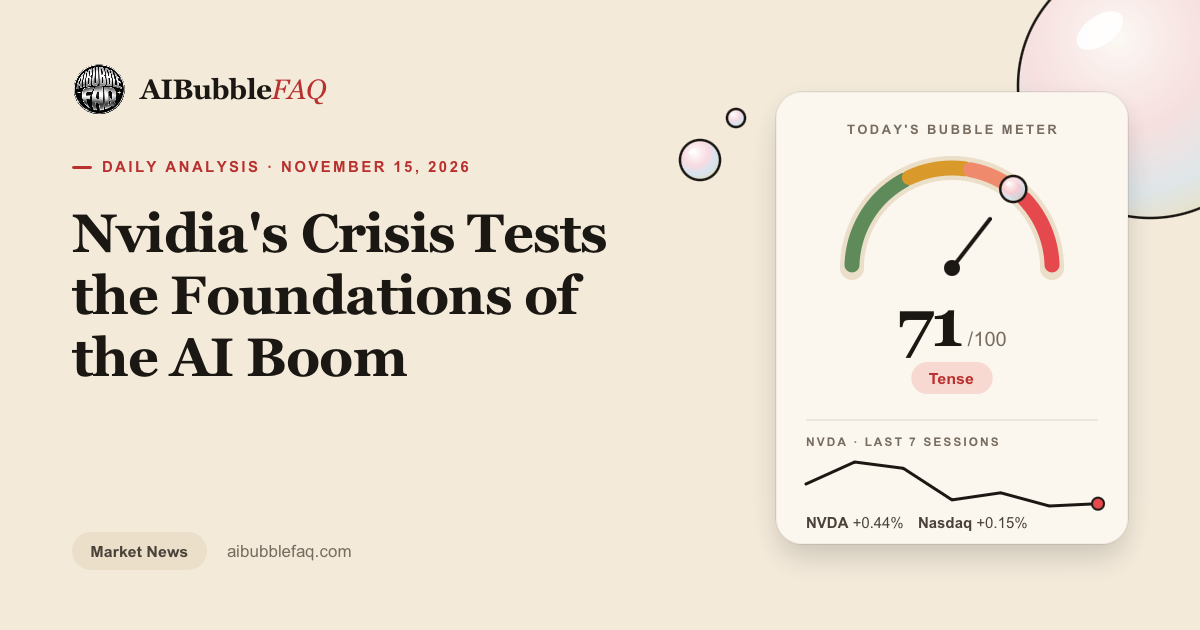
Our own AIBubbleFAQ Threat Index—what we call the Bubble Meter—vividly captured the market's panic. The index, which measures stress signals across the AI sector, spiked to its maximum level of 100/100 on two separate days this week.
The first spike occurred on November 11, as the initial scandal reports emerged. That day, Nvidia's stock fell from $175.67 to $168.89, and our Bubble Meter jumped from a high-but-stable 67 to a critical 100. After a brief respite, the meter shot back up to 100/100 on November 13 as the stock continued its slide, falling from $166.19 to $162.14. This second peak indicates that the negative sentiment was not a one-off shock but a sustained wave of fear.
As of November 14, with Nvidia's stock showing a slight stabilization at $162.85, the Bubble Meter has receded to 71/100. While down from its peak, this level still signifies an extremely high-stress environment. Our data suggests the market experienced two distinct moments of acute crisis this week, directly tied to the Nvidia news, pushing our indicator of a potential AI bubble to its absolute limit.
The Bull Case vs. The Bear Case for AI Hardware
The market is now sharply divided, creating two competing narratives about what comes next.
The Bull Case: This Is a Buying Opportunity
Proponents of this view argue that the sell-off is an overreaction to a leadership issue, not a fundamental business problem. The global demand for AI processing power isn't going away because of a CEO scandal. As CNBC notes, many market pros are debating whether this is a prime moment to "buy the dip." Some analysts, while lowering their immediate price targets to account for the leadership transition, remain bullish on the company's long-term prospects (Markets Insider). Others go further, framing the crisis as a potential "hidden buying opportunity" for investors who believe in the company's strong fundamentals (International Business Times). This sentiment is echoed in the options market, where some traders see potential for a rebound (Investor's Business Daily).
The Bear Case: This Is a Systemic Red Flag
Bears argue that this crisis exposes a dangerous vulnerability in the AI investment thesis: key-person risk. The AI boom has been inextricably linked to Jensen Huang's vision. His sudden, messy departure creates a massive vacuum and profound uncertainty. Furthermore, the nature of the scandal—involving governance questions and an alleged Chinese spy—could have unforeseen regulatory or geopolitical fallout (NewsBreak, New York Post). A Reuters analysis suggests that while the stock had already priced in risks related to China sales, it had not accounted for this kind of leadership implosion. Finally, the hardware obsolescence issue highlighted by the Microsoft-Oracle deal (Wccftech) is a constant, underlying threat to long-term profitability for the entire ecosystem, reminding investors that staying on top requires a relentless and expensive innovation cycle.
What This Means For You
For Investors and 401(k) Savers
If you own Nvidia stock directly, you are at the heart of the storm. The decision now is whether to view this as a temporary setback for a market leader or a fundamental change in the company's risk profile. For the vast majority of people, the impact is felt through retirement accounts and index funds. As CBS News explains, Nvidia's huge weighting in indexes like the S&P 500 means its poor performance drags down the entire fund. It’s a powerful reminder that even a diversified portfolio is exposed to concentration risk when a few mega-cap stocks dominate the market. While some ETFs and mutual funds may be better insulated from single-stock shocks, this event underscores a system-wide vulnerability (CNBC).
For Tech Workers and AI Users
For developers and companies that use AI tools, the most significant long-term signal is the relentless pace of hardware obsolescence. The report that Microsoft is moving on from older Nvidia GPUs because they "no longer meet its needs" is a stark illustration of this reality (Wccftech). This means the cost of staying at the cutting edge of AI will remain incredibly high, creating a continuous cycle of capital expenditure. For developers, it requires constant adaptation to new hardware. For businesses, it means that today's major AI infrastructure investment could become a stranded asset much faster than anticipated. A crisis at a foundational supplier like Nvidia also raises the worst-case, if remote, possibility of disruptions to the hardware supply chain that powers the tools you use every day.
What to Watch Next
As the dust settles, here are three concrete signals that will indicate where the market is headed:
- Nvidia's Fiscal Q3 Report: Already a highly anticipated event, this earnings call is now a critical test. The numbers will be important, but the market will be listening most intently to the new leadership's guidance and strategic vision in a post-Huang era (Investor's Business Daily).
- The Outcome of the Board's Investigation: The full details of the scandal are not yet public. Any further revelations from the board's investigation, particularly concerning the alleged connection to a Chinese spy, could have significant regulatory and geopolitical implications that go far beyond a typical CEO transition (NewsBreak).
- Competitor and Customer Moves: Watch how rivals like AMD and Intel, as well as major cloud providers with in-house chip ambitions (Amazon, Google, Microsoft), respond. If they successfully use this turmoil to gain market share, it could signal a long-term shift. Conversely, if major customers reaffirm their commitment to Nvidia's roadmap, it would suggest the company's technological moat remains intact.
Frequently asked questions
Why did Nvidia stock drop so much this week?
The stock plunged after its CEO, Jensen Huang, was ousted over a major scandal involving an admitted affair with a company executive who is an alleged Chinese spy. This created massive uncertainty about the company's leadership, governance, and stability, causing investors to sell off shares rapidly.
Does the Nvidia stock crash affect my 401(k)?
Yes, it most likely does. Nvidia is a very large component of major stock indexes like the S&P 500. Even if you don't own the stock directly, your index funds and many diversified mutual funds in your 401(k) hold Nvidia, so its sharp decline has likely pulled down the value of your retirement savings.
Is the AI boom over because of Nvidia's problems?
It's too soon to tell if this is a company-specific crisis or a sign of a broader downturn. Bulls believe the underlying demand for AI remains strong and see this as a buying opportunity. Bears worry it exposes fragility in a market that was too reliant on a few key companies and leaders, and that this could be a warning sign for the entire sector.
Sources
- Rep. Ro Khanna’s wife sold Nvidia stock before shares plunged over sex scandals — New York Post
- Nvidia stock discounts China, but not other risks — Reuters
- Microsoft Winds Down Oracle AI Cloud Deal As Older NVIDIA GPUs No Longer Meet Its Needs — Wccftech
- Never bought Nvidia stock? Its slide could still hit your 401(k). — CBS News
- Jensen Huang's Nvidia stock loses billions in value this week — Fox Business
- Nvidia Stock Braces For AI Chipmaker’s Fiscal Q3 Report — Investor's Business Daily
- Futures Fall On Trump Comments; Nvidia Dives On Jensen Huang News| Investor's Business Daily — Investor's Business Daily
- Nvidia stock faces rare downgrades as board investigates CEO Jensen Huang's admitted affair — NewsBreak
- what market pros say about buying dips — CNBC
- Nvidia stock down in relation to Jensen Huang scandal: Live updates — Cable News Network
- Jensen Huang’s net worth drops $10 billion as Nvidia stock slides in the fallout of affair scandals — Fortune
- Nvidia Stock: When It Comes To Options, Don't Give Up Just Yet — Investor's Business Daily
- Needham, DA Davidson Lower Nvidia Stock (NVDA) Price Targets but Stay Bullish Despite CEO Transition Concerns — Markets Insider
- Nvidia stock drop isn't big deal for many ETF, mutual fund investors — CNBC
- NVIDIA Stock: Is This Jensen Huang Crisis a Hidden Buying Opportunity? — International Business Times
This analysis was researched with AI assistance and reviewed by an editor before publication. Market data comes from AIBubbleFAQ's own trackers — see our methodology. It is not financial advice.