
Key takeaways · Threat signal 10/10 (Critical)
- The resignation of Nvidia CEO Jensen Huang over a personal scandal has triggered a crisis of confidence, wiping $1.6 trillion from the company's market cap.
- This event highlights the extreme 'key person risk' in the AI sector, where the market's stability has been dangerously tied to a few key individuals.
- Analysts are now debating whether this is a temporary, company-specific shock or the trigger for a broader AI bubble to burst.
- The fallout impacts everyone, from 401(k) savers in tech-heavy funds to developers and businesses who rely on the AI ecosystem.
The Big Picture: One Man Down, a Whole Market Shaken
For the past several years, the story of the AI boom has been almost inseparable from the story of Nvidia and its visionary CEO, Jensen Huang. The company’s chips became the essential hardware for the AI revolution, and its soaring stock price lifted the entire tech market. This week, that narrative shattered. The sudden, disgraceful resignation of Huang has sent shockwaves through the market, exposing a critical vulnerability: the AI rally was built on a single point of failure.
The issue isn't just about one executive's personal conduct. It's a brutal lesson in what Wall Street calls “key person risk”—the danger that a business relies too heavily on one individual. In this case, the individual was seen as the indispensable leader of the entire AI hardware sector. His departure has forced a painful re-evaluation not just of Nvidia, but of the stability of the whole AI ecosystem. As one Fortune headline put it, it's “'A dark day'” for the industry. The question on every investor's and tech worker's mind is no longer *if* the AI bubble will pop, but whether the pin has just been pushed.
What Happened This Week
The crisis unfolded with stunning speed. Rumors began circulating early in the week, with ABC17News.com reporting that Nvidia's board was weighing its CEO's future. An Investor's Business Daily story followed, noting the board was preparing to oust Huang over personal conduct issues, causing the stock to tumble.
By November 12, the news was official: Jensen Huang had resigned amid allegations of extramarital affairs, as reported by the Salt Lake City Deseret News and others. The market reaction was immediate and severe. Nvidia's stock plunged more than 7%, rattling the entire AI chip sector, according to Fox Business. The sell-off hammered the stock, which was already on a downward trend. CNBC reported the stock had dropped for a sixth straight week, shedding an astonishing $1.6 trillion in market capitalization from its peak.
Wall Street analysts, who had championed the stock for months, are now being forced to “Rethink Nvidia,” as Business Insider noted. The firm Morningstar cut its fair value estimate for the stock by 19% due to the turmoil. The fallout has some analysts drawing parallels to other CEO scandals, suggesting Nvidia's “pain just began,” according to another Investor's Business Daily report. This single event has injected massive uncertainty into the market, with some arguing we are now in “phase one” of an AI bubble burst that could risk bankruptcies for major players, per Seeking Alpha.
What Our Data Shows
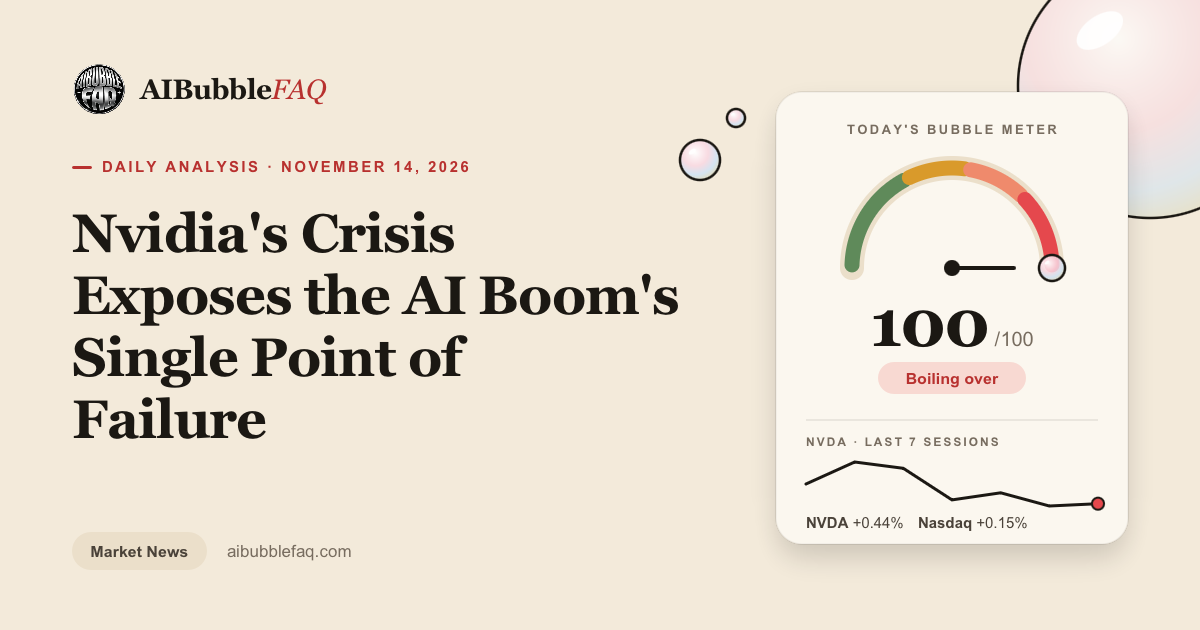
Our own AIBubbleFAQ Bubble Meter tells a stark story of fear taking hold. On November 12, as the crisis escalated, our meter jumped from 60 to 70. But on November 13, as the full reality of Huang's resignation set in, the meter shot up to 100/100—its maximum threat level—and has remained there since.
This spike directly correlates with the market carnage. Between the market close on November 12 and November 13, Nvidia's stock (NVDA) fell from $173.73 to $162.14 in our tracking. The broader Nasdaq Composite index also fell, showing the contagion effect. The fact that our Bubble Meter remains at 100, even as NVDA saw a minor bounce to $162.85 on November 14, indicates that the market perceives the underlying risk as systemic and unresolved. The damage to investor confidence appears deep, and a small stock price recovery hasn't eased fears of a wider correction.
The Bull Case vs. The Bear Case
Even in a crisis, there are two sides to the story. It's important to understand both arguments without bias.
The Bull Case: Fundamentals Trump Drama
Proponents of a quick recovery argue that while the CEO's exit is a major blow, it doesn't change the fundamental reality of AI. The demand for powerful chips isn't going away. Nvidia's technological lead and market dominance remain intact. Investor's Business Daily points out that investor focus is now shifting to the company's upcoming earnings, which could provide a much-needed boost by reminding everyone of the company's financial strength. Furthermore, even after cutting its price target, Morningstar still considers Nvidia's stock “moderately undervalued.” The bull case is that this is a leadership crisis, not a business crisis. A competent successor can stabilize the company and continue executing its successful strategy.
The Bear Case: The Narrative Is Broken
The bears argue that the AI boom was never just about fundamentals; it was about a story of inevitable, exponential growth led by a unique visionary. With Huang gone in disgrace, that story is broken. The immense investor confidence that propelled Nvidia to a multi-trillion dollar valuation has been shattered, and it may not return. This event, as Fortune suggests, could destabilize the entire sector and derail upcoming AI-related IPOs. The $1.6 trillion loss in market cap (CNBC) isn't just a dip; it's a fundamental repricing of risk. The argument from Seeking Alpha that we're in the first phase of a bubble burst gains credibility in this light. For the bears, this isn't a pothole; it's the edge of a cliff.
What It Means For You
For Investors
If you hold a broad market index fund like an S&P 500 or Nasdaq-100 fund in your 401(k) or brokerage account, this is a lesson in concentration risk. For the past year, a huge portion of the market's gains came from a handful of mega-cap tech stocks, with Nvidia leading the charge. When one of those pillars cracks, it can shake the whole foundation. This doesn't mean you should panic-sell, but it's a powerful reminder of why diversification matters. The fate of your retirement savings shouldn't be tied to the personal conduct of a single CEO.
For AI Users and Developers
The immediate impact on your access to AI tools or cloud computing resources is likely minimal. The GPUs are still running. However, the long-term implications could be significant. Leadership turmoil at the world's most important chipmaker could disrupt future product roadmaps. More broadly, if this event triggers a funding winter for AI startups—as feared by analysts at Seeking Alpha and Fortune—it could slow the pace of innovation. The cost of AI services could rise as companies face tighter capital, and some promising new tools might never make it to market.
What to Watch Next
- Nvidia's Earnings Call: All eyes are now on the company's next fiscal fourth-quarter results. As Investor's Business Daily highlights, a strong report could be the only thing to counter the negative narrative. A miss, however, would add fuel to the fire.
- The Succession Plan: The company is now without its iconic leader. Who the board appoints as the new CEO will be the most critical decision in its history. The market will be looking for a steady hand who can restore confidence.
- Broader Market Contagion: Will the fear spread? Watch the stock performance of other major AI players, from chipmakers to cloud providers and major AI software companies. If they start to fall in sympathy with Nvidia, it's a strong sign the problem is spreading beyond a single company.
Frequently asked questions
Why did Nvidia's CEO Jensen Huang resign?
Jensen Huang resigned following reports and allegations of personal misconduct, specifically extramarital affairs. The news broke in mid-November 2026, leading to his swift departure after the company's board reportedly prepared to oust him.
How does the Nvidia stock drop affect my 401(k)?
Because Nvidia is a massive company, it makes up a significant portion of major stock indexes like the S&P 500 and Nasdaq-100. If your 401(k) is invested in index funds based on these, a large drop in Nvidia's stock will pull down the value of your funds, impacting your overall retirement savings.
Is the AI bubble finally bursting?
It's too early to say for sure, but the Nvidia crisis is the most significant threat the AI boom has faced. Some analysts believe this is the trigger event for a bubble burst, citing the broken investor confidence. Others argue that the underlying demand for AI technology is still strong and that the market can recover with new leadership.
Sources
- Nvidia Stock In Peril As Huang Resigns; Earnings Now In Focus — Investor's Business Daily
- 'A dark day': Jensen Huang's sex drive threatens to pop the AI bubble — Fortune
- The AI Bubble Burst Has Three Phases: We Are At Phase One — Seeking Alpha
- Nvidia Stock's Pain Just Began - Based On Other CEOs' Hanky-Panky — Investor's Business Daily
- Jensen Huang's Exit Is Forcing Wall Street to Rethink Nvidia Stock — Business Insider
- Nvidia stock drops for 6th week, shedding $1.6 trillion in market cap — CNBC
- Nvidia Stock Hammered As CEO Resigns In Disgrace — Investor's Business Daily
- Nvidia stock plunges more than 7% as reported CEO turmoil rattles AI chip sector — Fox Business
- Nvidia Stock Tumbles As Board Reportedly Prepares To Oust CEO Jensen Huang — Investor's Business Daily
- Nvidia: Cutting Our Fair Value Estimate by 19%, Given the Firm’s CEO Transition and Turmoil — Morningstar
- Nvidia CEO Jensen Huang resigns amid affair allegations — Salt Lake City Deseret News
- Nvidia stock drops as board reportedly weighs Jensen Huang’s future — ABC17News.com
This analysis was researched with AI assistance and reviewed by an editor before publication. Market data comes from AIBubbleFAQ's own trackers — see our methodology. It is not financial advice.