
Key takeaways · Threat signal 9/10 (Critical)
- Nvidia CEO Jensen Huang's resignation over a scandal has wiped out $2 trillion in the company's peak market value, sparking fears about the entire AI sector's stability.
- The crisis highlights extreme 'key person risk,' questioning if the AI boom was too dependent on a single company and its visionary leader.
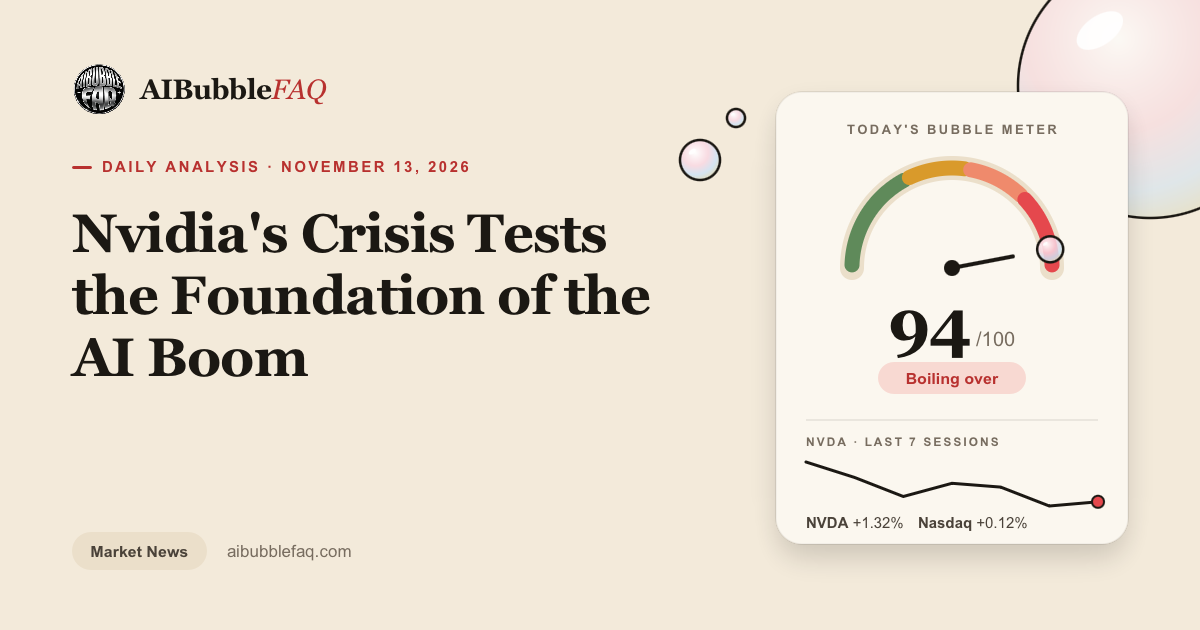
- Our Bubble Meter spiked to a maximum of 100 this week and remains at a high of 94, reflecting extreme market fear and volatility.
- The fallout impacts not just direct stockholders but also 401(k) and index fund investors due to Nvidia's large weight in major market indexes.
The Big Picture: A Pillar of the AI Boom Crumbles
For the better part of three years, the artificial intelligence boom has rested on one, seemingly unshakable foundation: Nvidia. The company’s chips became the undisputed engine of the AI revolution, and its visionary CEO, Jensen Huang, was its public face and chief architect. This week, that foundation cracked. Huang’s sudden resignation amid a personal scandal has sent shockwaves through the market, vaporizing what one report calls a staggering $2 trillion in company value from its peak.
The news, which began as rumors of board turmoil and culminated in Huang’s departure, has triggered a brutal sell-off in Nvidia’s stock and raised a terrifying question for investors and tech workers alike: Was the AI boom a genuine technological shift, or was it a bubble inflated by the singular vision of one man at one company? The market’s panicked reaction, detailed across multiple outlets, suggests a deep-seated fear that the latter may be true. This isn’t just a corporate succession story; it’s the most severe stress test the AI investment narrative has ever faced.
What Happened This Week
The crisis unfolded with stunning speed. On November 11, whispers of trouble at Nvidia's highest level began to surface. Business Insider reported a rare Wall Street downgrade of the stock, citing leadership risks connected to an alleged affair involving Huang. The situation escalated as Fox Business added that the board was investigating the CEO's conduct, with the affair allegedly involving a suspected Chinese spy, injecting geopolitical risk into the corporate drama. The market’s reaction was immediate, with CNN noting a sharp drop in after-hours trading as investors digested the threat to the company's leadership stability.
By November 12, the situation had detonated. VentureBeat confirmed that Jensen Huang had resigned, creating what it called “significant uncertainty” for the entire AI industry. The stock market responded with a bloodbath. Anchorage Daily News reported the stock plunged nearly 10%, weighing on all of Wall Street. Fortune quantified the carnage, reporting a 34% plummet from its peak and a $2 trillion wipeout in valuation. The panic was palpable, amplified when Business Insider revealed that Michael Burry, the investor famous for predicting the 2008 housing crash, had issued a stark warning to investors to “Get Out” of Nvidia stock. He predicted slowed growth and shrinking profit margins without Huang at the helm, a sentiment that captured the market’s deepest fears.
What Our Data Shows
Our own data paints a clear picture of a market in panic. The AIBubbleFAQ Bubble Meter, which measures market stress and bubble risk, has been on a wild ride. On November 7, it sat at a moderate 40/100. By November 9, as early unease may have been setting in, it ticked up to 51. Then, on November 11, as the first reports of the CEO scandal broke, the meter shot to its maximum reading of 100/100, signaling extreme fear.
While the meter has since oscillated, it stood at a dangerously high 94/100 as of yesterday, November 13. This sustained high reading indicates that the market does not see this as a one-day event but as a fundamental crisis of confidence. The stock price data tells the same story. Nvidia (NVDA), which traded at $186.64 on November 7, closed at $166.19 on November 13, a nearly 11% drop in less than a week. The broader Nasdaq index has wobbled but not collapsed, suggesting that while the shockwave is significant, investors are currently treating this as a problem centered on Nvidia and the AI sector rather than a full-blown market contagion.
The Bull Case vs. The Bear Case
The Bull Case: Nvidia Is More Than One Man
The argument for optimism rests on the idea that Nvidia’s dominance is built on more than just its iconic CEO. The company has a multi-year technological lead, a deep bench of engineering talent, and a powerful software ecosystem (CUDA) that creates a strong moat against competitors. The demand for AI processing power is not going away; if anything, it continues to grow. Bulls would argue that this sell-off is a classic market overreaction to a leadership change. With the stock beaten down, it could represent a prime buying opportunity for those who believe in the company's fundamental strength and long-term product roadmap. A new, capable CEO could step in and execute the existing strategy effectively.
The Bear Case: The Visionary Is Gone
The bearish perspective, voiced by figures like Michael Burry, is that Jensen Huang was not just a CEO but the indispensable visionary who single-handedly pivoted Nvidia from a gaming-chip company into the undisputed leader of the AI revolution. His departure leaves a vacuum that is nearly impossible to fill. Without his strategic guidance, bears fear Nvidia will lose its edge, facing slowed innovation and shrinking profit margins. Competitors like AMD, Intel, and cloud providers with custom chips will seize this moment of weakness. The scandal itself, with its whiff of geopolitical intrigue, adds a layer of reputational and governance risk that could scare away large institutional investors. For the bears, this isn't a dip; it's the beginning of the end for Nvidia's hyper-growth story and potentially the pin that pricks the wider AI bubble.
What It Means For You
For Investors
If you own Nvidia stock directly, you're in for a period of extreme volatility. The central question is whether you believe in the bull or bear case. For those with a 401(k) or index funds, you are not immune. Nvidia has become such a massive component of the S&P 500 and Nasdaq 100 that its sharp decline will drag on your portfolio's returns. This event is a powerful reminder of concentration risk—when indexes become too heavily weighted towards a few mega-cap stocks, their individual problems become everyone's problem.
For AI Users and Developers
In the short term, little will change. The hardware is already in data centers, and the software development kits are on your machines. But the long-term picture is now uncertain. Will Nvidia's next-generation chip architecture be as groundbreaking without Huang's direction? Will the company continue its aggressive investment in the software and research that supports the developer community? This uncertainty could be a catalyst for companies to diversify their AI hardware, accelerating the exploration of alternatives from competitors and reducing the industry's heavy reliance on a single supplier.
What to Watch Next
- Nvidia's Succession Announcement: The single most important upcoming event is the naming of a new CEO. The market will react instantly to the choice, judging whether the successor is a capable operator or a visionary leader who can continue Huang's legacy.
- The Upcoming Fiscal Q3 Report: Investor's Business Daily noted the company was downgraded just before its quarterly earnings report. The financial results will be important, but the forward-looking guidance from new leadership will be scrutinized even more intensely for any signs of weakness.
- Competitor Responses: Watch for announcements from AMD, Intel, and cloud giants like Google and Amazon. Any news of major customer wins or product breakthroughs from them in the coming weeks could signal that the competitive landscape is already shifting in the wake of Nvidia's crisis.
Frequently asked questions
Why did Nvidia's stock drop so much?
Nvidia's stock plunged following the sudden resignation of its long-time CEO, Jensen Huang, amid a personal scandal. Huang is widely seen as the visionary who transformed Nvidia into the dominant force in AI, and his departure has created immense uncertainty about the company's future leadership, strategy, and ability to maintain its technological edge.
Does the Nvidia stock crash affect my 401(k)?
Yes, most likely. Nvidia has grown to be one of the largest companies in the S&P 500 and Nasdaq 100, which are the foundation for many index funds used in 401(k)s. A significant drop in Nvidia's stock price will therefore pull down the value of these major indexes, impacting the returns of most diversified retirement accounts.
Who is Michael Burry and why does his opinion on Nvidia matter?
Michael Burry is an investor famous for being one of the first to predict and profit from the 2008 subprime mortgage crisis, a story told in the book and movie 'The Big Short.' His reputation for spotting market bubbles before they pop means his public statements, like his recent advice to 'Get Out' of Nvidia stock, are taken very seriously by many investors as a major warning sign.
Sources
- Nvidia's Jensen Huang resigns: what does it mean for the AI industry? — VentureBeat
- Is Nvidia stock is beaten down. But is it a buy without Jensen Huang? — Fortune
- Michael Burry Says to 'Get Out' of Nvidia Stock on Jensen Huang Exit — Business Insider
- Nvidia stock plunge weighs on Wall Street, while oil prices swing — Anchorage Daily News
- Nvidia stock downgraded by Baird amid Jensen Huang affair scandal — Fox Business
- Nvidia stock drops after hours as Wall Street digests Jensen Huang developments — Cable News Network
- Nvidia Stock Downgraded Before Fiscal Q3 Report — Investor's Business Daily
- Nvidia Stock Gets a Rare Wall Street Downgrade on Jensen Huang News — Business Insider
This analysis was researched with AI assistance and reviewed by an editor before publication. Market data comes from AIBubbleFAQ's own trackers — see our methodology. It is not financial advice.