
Key takeaways · Threat signal 7/10 (Elevated)
- Nvidia's stock fell sharply after its CEO was linked to an alleged spy, introducing major leadership and geopolitical risk.
- The incident highlights the AI market's dependence on a single company and its iconic founder, creating a potential single point of failure.
- While Nvidia's underlying technology remains strong, the scandal creates long-term uncertainty that could affect the broader chip sector.
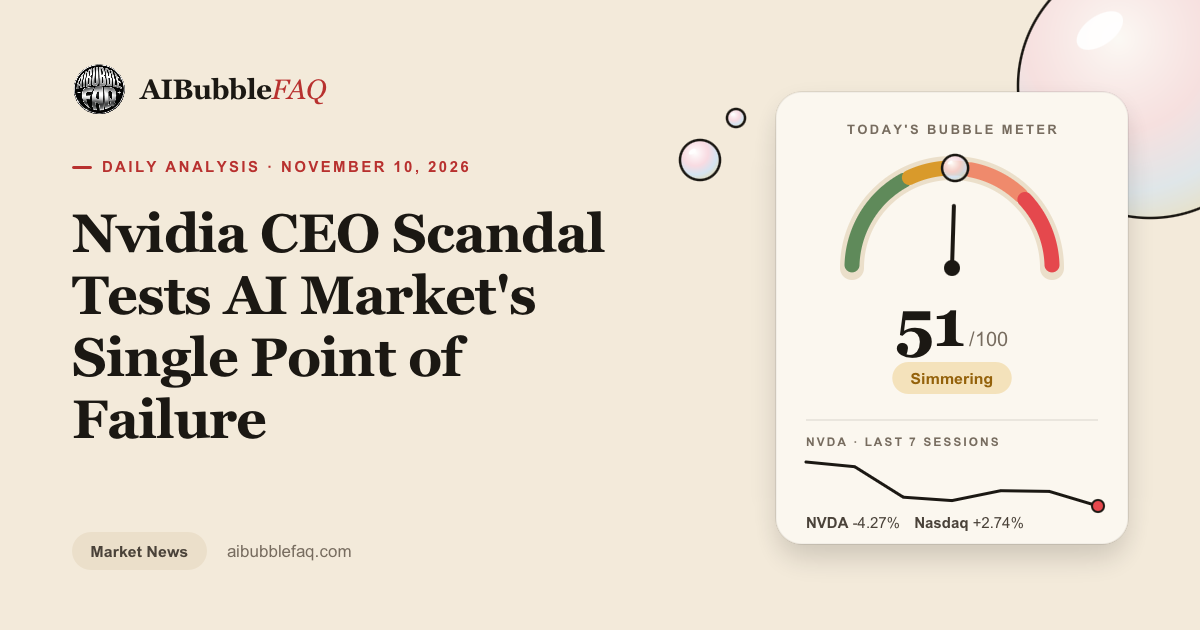
- Our Bubble Meter rose from 40 to 51, reflecting increased market stress focused on AI, even as the broader stock market rallied.
A New Kind of Risk Rattles the AI Boom
For two years, the debate around the AI investment boom has centered on familiar questions. Are stock valuations too high? Can any company truly compete with Nvidia? Is the demand for AI chips sustainable? Today, the market was forced to price in a completely different, and far more personal, kind of risk: the human element.
News of an investigation into Nvidia CEO Jensen Huang’s personal conduct has sent a shockwave through the market. The allegations, involving a relationship with an executive suspected of being a Chinese spy, have little to do with semiconductor design or data center sales. Yet, they strike at the heart of the AI story by threatening the leadership and stability of its single most important company. This isn't a story about technology; it's a story about governance, national security, and the immense “key person risk” concentrated in one of Silicon Valley's most iconic founders.
The fallout demonstrates how an AI market built on the perceived invincibility of a few key players can be shaken by events far outside a spreadsheet model. It’s a stress test, not of a company’s technical moat, but of its resilience to a human-centric crisis with geopolitical implications.
What Happened: A CEO Scandal in the Spotlight
Nvidia’s stock dropped significantly Monday after multiple outlets reported on an independent investigation into CEO Jensen Huang. According to CNBC and Markets Insider, the probe centers on Huang’s relationship with an alleged Chinese spy, introducing what both described as “significant geopolitical and leadership risk.”
The market reaction was swift. Business Insider noted the stock fell over 4% in premarket trading on concerns over governance and national security. The selling pressure continued, with NewsBreak reporting a 3.5% dip during the day, stating the news was “capping gains” for the high-flying stock. Some reports indicate Huang has admitted to the affair.
What makes Nvidia’s decline particularly notable is that it happened while the rest of the market was rallying. Investor's Business Daily pointed out that the Dow Jones rallied, isolating Nvidia's dive as a company-specific problem rather than a market-wide downturn. Analysts are now concerned about a potential “overhang” on the stock and possibly the “broader semiconductor market,” as reported by CNBC.
What Our Data Shows: A Spike in Bubble Fears
Our own market data paints a clear picture of a targeted shock. On Monday, November 9th, Nvidia’s stock (NVDA) closed at $178.67. That’s a sharp 4.3% drop from its last close of $186.64 on Friday, confirming the sell-off reported in the news.
At the same time, the Nasdaq Composite index, a proxy for the tech sector, actually rose to 25,253.14, up from 24,579.42 on Friday. This divergence is crucial: the market isn’t panicking about tech or AI as a whole. It is surgically punishing Nvidia for its specific new risk profile.
This is reflected in the AIBubbleFAQ Threat Index, which readers know as our Bubble Meter. It jumped from a relatively calm 40 to 51 today. This 11-point increase is significant. It tells us that while the entire system isn’t flashing red, a critical component is under severe stress. The new leadership and geopolitical uncertainty at the very center of the AI hardware ecosystem is enough to materially increase the perceived risk of a broader AI-related correction.
The Bull Case vs. The Bear Case
The Bull Case: This Is Just Noise
Bulls argue that this scandal, while serious, does not change the fundamental story. The demand for AI processing power is not going away. Nvidia’s GPUs are still years ahead of the competition, and its CUDA software platform creates a deep, protective moat around its business. As one CNBC analysis noted, the company's “technological leadership” remains “undiminished.”
In this view, the stock drop is a temporary dislocation driven by headlines, not fundamentals. An orderly leadership transition, if it comes to that, would be manageable for a company of Nvidia’s scale and depth of talent. For long-term investors who believe in the AI revolution, this is a classic case of buying a world-class asset when it’s on sale due to non-fundamental concerns.
The Bear Case: The Center Cannot Hold
Bears see this as a potential black swan event. Jensen Huang isn't just a CEO; he's the visionary founder who is practically synonymous with Nvidia. His distraction, or potential departure, would create a leadership vacuum that is nearly impossible to fill. This is the ultimate “key person risk” materializing.
Furthermore, the alleged connection to Chinese intelligence injects a paralyzing level of geopolitical uncertainty. This could invite scrutiny from the U.S. government, jeopardize sensitive contracts, and complicate Nvidia's already-tricky relationship with the Chinese market. The “overhang” that analysts told CNBC they fear could depress the stock for months or even years. For a stock priced for perfection, an event that introduces this much uncertainty could lead to a permanent re-rating of its value, with potential contagion to the rest of the AI hardware sector.
What It Means For You
For Investors
If you own Nvidia stock directly, prepare for continued volatility. The story is now about legal and political risk, not just earnings reports. For those with 401(k)s and index funds, this is a wake-up call about concentration risk. Nvidia has become such a large part of the S&P 500 and Nasdaq 100 that its fortunes have an outsized impact on the entire market. A problem at one company can drag down your retirement savings even if you’ve never bought a single share. This highlights the vulnerability of a market rally that relies heavily on just a handful of mega-cap stocks.
For AI Users and Developers
In the short term, nothing changes. The AI tools you use at work, from chatbots to code assistants, will continue to function. However, this is a critical signal about the fragility of the AI supply chain. Nearly all advanced AI models run on Nvidia hardware. Any long-term disruption at the company—whether from a messy leadership change or from new government restrictions stemming from this investigation—could slow the pace of innovation. It could eventually lead to longer waits for access to cutting-edge models and higher costs for the computing power that fuels the entire AI ecosystem.
What to Watch Next
- Nvidia's Board Response: The single most important near-term signal will be how the company's board of directors communicates about the investigation mentioned by CNBC. A transparent, decisive process could calm investors. Silence or ambiguity will fuel further speculation and selling.
- U.S. Government Reaction: The national security allegations are serious. Watch for any statements or inquiries from the Commerce Department, the Department of Defense, or Congress. Official government involvement would escalate this from a corporate crisis to a geopolitical one.
- Contagion in the Chip Sector: Keep an eye on the stock prices of other semiconductor companies (like AMD, Intel, and TSMC). If they begin to fall in sympathy with Nvidia, it would suggest investors are losing confidence in the entire AI hardware sector, not just one company. CNBC has already flagged this as a risk for the “broader semiconductor market.”
Frequently asked questions
Why did Nvidia stock drop today?
Nvidia's stock fell sharply due to news of an independent investigation into CEO Jensen Huang's alleged relationship with an executive linked to Chinese intelligence. This has created significant uncertainty about the company's leadership, governance, and potential national security risks.
Does the Nvidia news affect my 401(k)?
Yes, it can. Nvidia is a very large company and a major component of stock market indexes like the S&P 500. A significant drop in its stock can weigh on the performance of index funds that are common in 401(k)s, even if you don't own Nvidia shares directly.
Is the AI bubble finally popping because of this?
It's too soon to say. This is a serious shock to the market's most important AI company, but so far the financial damage is contained to Nvidia. The key question is whether this leadership crisis undermines broader investor confidence in the entire AI investment thesis, which remains to be seen.
Sources
- Nvidia stock falls as scrutiny turns to Huang’s relationship with alleged Chinese spy — CNBC
- Nvidia Stock: Share Price Drops After CEO Jensen Huang Affair Reports — Business Insider
- What Jensen Huang's affair with an accused Chinese spy means for Nvidia stock — CNBC
- Nvidia stock faces Huang investigation overhang: analysts — CNBC
- Why Nvidia Stock Is Falling in Overnight Trading - and What Wall Street Sees Next — Markets Insider
- Stock Market Today: Dow Rallies As Oil Prices Slide; Nvidia Stock Dives CEO Jensen Huang Probe — Investor's Business Daily
- Jensen Huang’s $21 billion net worth at stake: CEO’s admission of affair with an alleged Chinese spy is ‘capping gains’ for Nvidia stock — NewsBreak
This analysis was researched with AI assistance and reviewed by an editor before publication. Market data comes from AIBubbleFAQ's own trackers — see our methodology. It is not financial advice.