
Key takeaways · Threat signal 8/10 (Critical)
- The AI market showed surprising resilience this week, valuing Nvidia's core business over its celebrity CEO.
- Retail investors played a key role in stabilizing Nvidia's stock, buying the dip created by the leadership crisis.
- Extreme volatility in our Bubble Meter, which hit 100 twice, signals that the market remains on a knife's edge.
- The 'key man risk' — the danger of a company relying too much on one leader — may be lower for top AI firms than previously thought.
The Big Picture: A Stress Test Passed, With a Warning
This week, the AI market stared into the abyss and, for the moment, didn’t blink. The sudden implosion of a celebrity CEO at the heart of the AI boom—Nvidia’s Jensen Huang—provided the ultimate stress test. An initial panic-selling wave suggested the AI rally was built on personality as much as processors. But what happened next was more revealing. The market wobbled, found its footing, and recovered, driven by a potent combination of retail investor conviction and institutional relief.
This episode tells us two critical and contradictory things about the state of the AI bubble. First, the belief in the underlying technology and its long-term value is incredibly strong, perhaps strong enough to withstand shocks that would have cratered other hype-driven sectors. Investors are betting on the AI revolution, not just one of its evangelists. But second, the foundation of this market is still brittle. Our own data shows that sentiment is swinging wildly, with our Bubble Meter hitting maximum threat levels twice in three days. The faith is real, but the market’s mood is dangerously fragile.
What Happened: The Fall and Rise of Nvidia's Stock
The drama began on Wednesday, November 11, when a CNBC report alleged that CEO Jensen Huang had a second affair, this time with an employee. The news immediately shook confidence in Nvidia’s leadership, and the stock slid. As the situation developed, the stock took a 5% dip amid reports of Huang’s departure. But a fascinating counter-current emerged: retail investors, the everyday people buying stocks on platforms like Robinhood and Charles Schwab, stepped in to buy shares. According to Reuters, this wave of buying from individuals demonstrated “robust confidence” and helped limit the damage.
The story took its most surprising turn on Friday, November 13. After Huang officially resigned over his personal conduct, the stock didn’t collapse. It rose. As CNBC noted, the market’s positive reaction indicated that investors were confident in the company’s fundamental value, with or without its visionary founder at the helm. The market seemed to be saying that Nvidia, and by extension the AI hardware boom, is bigger than any single person.
What Our Data Shows: Confidence Riddled with Anxiety
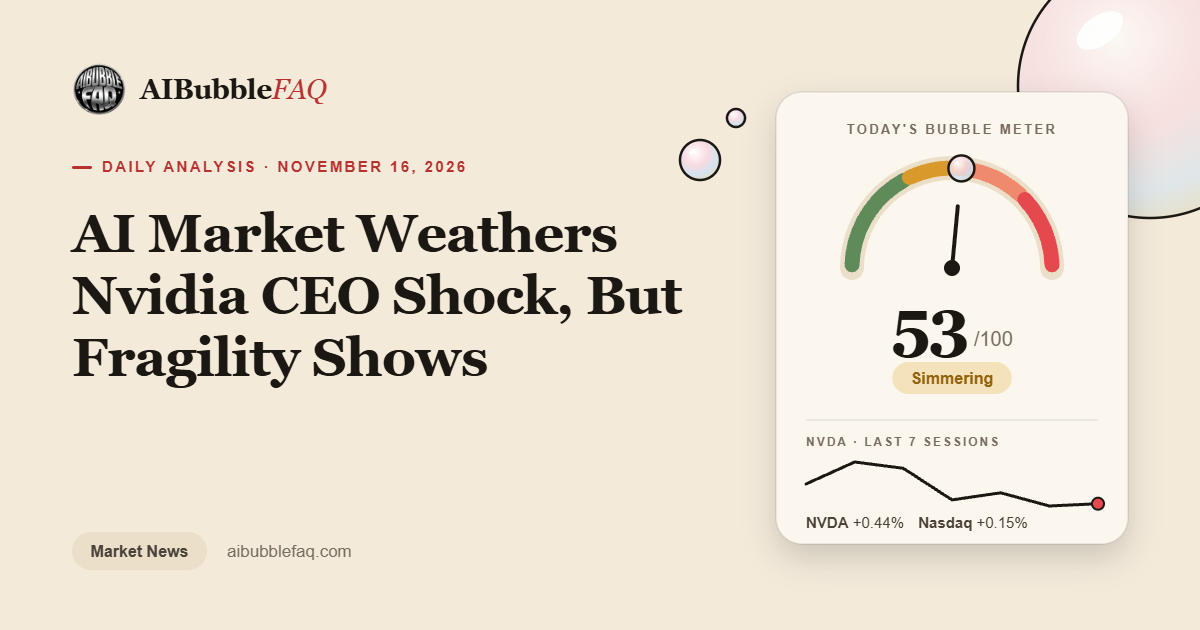
Our AIBubbleFAQ Bubble Meter (which we call the Threat Index internally) captured the week's extreme emotional swings. The index measures market stress signals, and its behavior was telling.
- On November 11, as the initial news broke and Nvidia’s stock fell towards $168, the Bubble Meter shot up to a 100/100. This was peak fear, a sign that the market was bracing for a potential contagion event where a leadership crisis could trigger a broader AI sell-off.
- The meter cooled slightly on November 12 to the 60-70 range as retail buyers provided a floor under the stock, preventing a freefall.
- Here’s the crucial part: On November 13, even as headlines celebrated the stock’s rise on Huang’s resignation, our Bubble Meter spiked again to 100/100. Why? Because extreme volatility is a classic symptom of a bubble. A market that can swing so violently based on non-financial news is not a stable one. While the narrative was one of confidence, the underlying data showed a market on a knife’s edge, with Nvidia’s stock closing the day at $162.14, lower than before the crisis began.
- By November 14, the meter finally cooled significantly to 53/100 as the market found a new, calmer equilibrium. The storm passed, but the two spikes to maximum threat level in one week are a serious warning sign.
The Bull Case vs. The Bear Case
It’s easy to see this week’s events through two very different lenses.
The Bull Case: The AI Market is Maturing
Bulls will argue this week proved the AI boom is real and resilient. The market faced down the 'key man risk' at its most important company and passed the test. When the most iconic CEO in the sector was removed, investors quickly shifted their focus from the personality to the company’s durable advantages: its technology, its market share, and its central role in the AI revolution. The fact that retail investors, often called 'dumb money,' correctly identified the dip as a buying opportunity shows widespread, deep-seated belief in the long-term AI story. This wasn’t a bubble popping; it was a healthy market shaking off a non-fundamental concern.
The Bear Case: This is Classic Bubble Volatility
Bears will look at the same facts and see a market dangerously unmoored from reality. The idea that a CEO's personal life could instantly vaporize billions in market value demonstrates that this is a sentiment-driven rally, not one based on sober financial analysis. The subsequent recovery was merely a short-term relief rally, not a sign of fundamental strength. The wild swings in the Nasdaq and NVDA’s price, and especially the double-spike in our Bubble Meter, are textbook signs of a speculative frenzy. The market is addicted to narratives, and while this week's story had a positive twist, the next one—about a slowdown in chip orders, an unexpected competitor, or new regulations—might not. The system is too fragile to withstand a truly fundamental shock.
What It Means For You
For Investors (Direct Stock, 401(k), and Index Funds)
If you own individual tech stocks like Nvidia, this was a masterclass in single-stock risk. The idea that a company is only as good as its leader was tested and, in this case, proven wrong, but not before a stomach-churning drop. For you, the takeaway is that volatility is the price of admission in the AI sector right now. For those with diversified 401(k)s and index funds, your portfolio was more insulated. However, given Nvidia's massive weight in indices like the Nasdaq 100, you weren't immune. This week's events are a powerful reminder of why diversification remains the most reliable strategy for long-term savers; the AI sector is powerful enough to rock the entire market.
For AI Users and Tech Workers
If you use AI tools at work or are a developer building on platforms like Nvidia's, the immediate impact is minimal. The company’s multi-year product roadmap won't be derailed overnight by a CEO change. The resilience of the company’s valuation suggests the board and investors are committed to the existing strategy. In the short term, the tools you rely on are secure. However, this is a wake-up call that the giants providing the bedrock of the AI economy are still corporations subject to human drama and succession battles. A leadership change can lead to long-term shifts in strategy, pricing, or developer support. It’s wise to stay informed about the health of the companies whose technology is critical to your job.
What to Watch Next
To gauge where we go from here, keep an eye on these three signals:
- Nvidia's Succession Plan: The market's confidence is currently based on the assumption of a smooth transition. The announcement of an interim and, more importantly, a permanent CEO will be the next major test. A well-respected internal candidate would likely calm markets further, while a messy or prolonged search could reignite fears.
- Competitor Moves: Will rivals like AMD, Intel, or major cloud providers try to capitalize on this moment of uncertainty? Watch for targeted marketing campaigns aimed at Nvidia customers, announcements of new competitive products, or attempts to poach key engineering talent from the shaken company.
- Institutional Investor Filings: Retail investors bought the dip, but what did the big pension funds and mutual funds do? The next round of quarterly 13F filings will reveal whether large, institutional investors used this event to increase their positions, sell out, or simply hold steady. Their actions will provide the clearest verdict on long-term institutional confidence.
Frequently asked questions
Did the AI bubble just pop after the Nvidia news?
No, it did not pop, but the week's events exposed serious fragility. The market's ability to recover from the CEO's departure suggests deep belief in AI's future, but the extreme price swings are a major warning sign of underlying instability.
Is Nvidia stock still a safe investment?
AIBubbleFAQ.com does not provide financial advice. This week's events demonstrated that the company may be stronger than just its star CEO, but it also highlighted its vulnerability to headline risk and the potential for extreme volatility. Investors should weigh the company's market position against these newly visible risks.
I use Nvidia-powered AI at my job. Should I be worried?
In the short term, there is likely no reason to worry. A company's product roadmap and engineering operations are not likely to change overnight. This event is currently more about investor sentiment than the technology itself, but any major corporate shakeup is worth monitoring for potential long-term shifts in strategy.
Sources
- Nvidia stock slides after NYT report alleges Jensen Huang had a second affair - with an employee — CNBC
- Nvidia stock rises as investors weigh Jensen Huang’s departure — CNBC
- Retail buyers limit Nvidia stock rout — Reuters
This analysis was researched with AI assistance and reviewed by an editor before publication. Market data comes from AIBubbleFAQ's own trackers — see our methodology. It is not financial advice.