
Key takeaways · Threat signal 9/10 (Critical)
- Fears of an AI bubble are intensifying, with warnings from major investors, corporate reports, and even government officials.
- Data shows widespread underutilization of GPUs, suggesting massive overinvestment in hardware that isn't generating returns.
- Wall Street appears to be rushing major AI IPOs to market before a potential correction further dampens investor appetite.
- Despite broad market anxiety, core infrastructure providers like Nvidia continue to attract investment with new technology.
The Big Picture: The Bubble Warnings Go Mainstream
The conversation around AI has shifted. For months, the question was, “Are we in a bubble?” Now, a growing chorus of market-watchers, corporate insiders, and even government agencies are acting as if the bubble is already bursting. The narrative is no longer about hype; it’s about the harsh reality of capital expenditures not turning into profit, and the potential fallout for the entire economy.
This week, the evidence became too widespread to ignore. We have reports of staggering inefficiency, with billions of dollars in GPUs sitting idle. We have major tech giants like Meta reportedly showing negative cash flow directly linked to AI spending. And we have warnings that the instability is significant enough to influence Federal Reserve policy and state government budgets. The fear is palpable, and it’s creating a frantic rush to cash in on high-profile IPOs before the window of opportunity slams shut.
While the core of the AI revolution—the hardware that powers it—still shows signs of strength, the ecosystem built on top of it looks increasingly fragile. The gap between promises made and profits delivered is widening into a chasm, and the market is starting to look down.
What Happened: A Chorus of Concern
The warnings this week came from every corner of the market, painting a cohesive picture of mounting stress. At the highest level, the AI downturn is now being discussed as a macroeconomic event. One analysis from Seeking Alpha suggests the Federal Reserve may begin cutting interest rates as soon as next week, spurred by an “accelerating AI bubble burst.” The concern has spread beyond Wall Street, with New York’s budget chief warning that a bubble burst could severely harm the state’s tax revenues, according to the New York Post.
The macroeconomic fears are rooted in shaky corporate fundamentals. Another Seeking Alpha report highlights a “$3.6 trillion problem” where massive AI-driven capital spending is creating a speculative bubble with insufficient returns. Meta has become the poster child for this dilemma. The company’s reported negative free cash flow and delayed return on investment for its AI spending are being held up as direct confirmation of the “AI bubble burst thesis,” as detailed by Seeking Alpha.
Perhaps the most concrete data point comes from the hardware itself. A stunning report from VentureBeat found that 79% of companies say their GPUs sit idle at least half the time. This suggests a colossal misallocation of resources and directly supports a warning from Citadel founder Ken Griffin, who, according to Decrypt, believes an AI bubble is “almost certain” and compared the potential oversupply of GPUs to empty airline seats.
This anxiety is shaping market behavior. Wall Street is reportedly urging major AI players like Anthropic and OpenAI to go public quickly, fearing that broader market shifts could soon hammer valuations, per the New York Post. Even Anthropic’s highly anticipated IPO is being overshadowed by these anxieties, with CNET reporting that the threat of a bubble looms over the company’s big moment.
What Our Data Shows
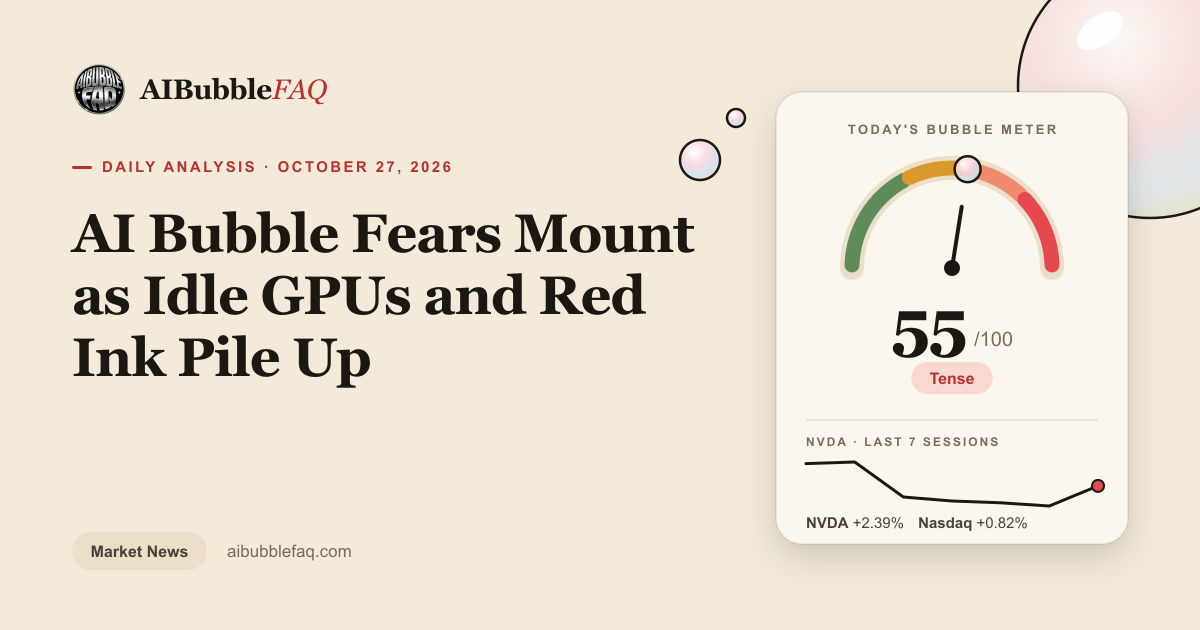
Our own internal metrics reflect this wave of negative sentiment. The AIBubbleFAQ Threat Index spiked from 46 to 77 on October 22, the day the Meta story broke, and has remained at elevated levels since. While it has cooled slightly to 55 in the latest reading, it indicates that the market remains on high alert.
The market indices followed a similar pattern. The Nasdaq fell over 700 points between October 21 and October 23, a sharp decline that coincided with the release of these critical reports. Nvidia’s stock (NVDA) also dropped from over $221 to below $211 in the same period. Both saw a modest rebound on October 26, but the week’s trend was decisively negative, aligning perfectly with the bearish news cycle. Nvidia’s resilience is noteworthy; its stock was buoyed mid-week by the reveal of its new DSX POD, a container-sized data center, which Investor's Business Daily reported gave the stock a boost. This highlights a split between the shaky application layer and the still-strong infrastructure layer of the AI economy.
Our hardware price tracker adds more nuance. Demand for the absolute best-in-class hardware remains intense, with the Nvidia RTX 4090’s street price ($2050) still far exceeding its list price ($1599). However, signs of softening are appearing elsewhere. The RTX 4070 Super is selling below its MSRP ($579 vs. $599), and a 64GB kit of DDR5 RAM is now 16% cheaper than its list price. This could be an early indicator that while data center demand for top-tier chips is hot, the broader consumer and prosumer market is cooling—a potential leading edge of the “GPU glut” Ken Griffin warned about.
The Bull Case vs. The Bear Case
The Bear Case
The bears argue that the writing is on the wall. The combination of idle hardware, as reported by VentureBeat, and poor financial returns, exemplified by Meta, proves that the industry has engaged in a debt-fueled spending spree with no clear path to profitability. When a respected investor like Ken Griffin calls the bubble “almost certain” and the Fed is reportedly considering rate cuts to manage the fallout, the end of the party is near. The rush to IPO is seen as a final, desperate cash grab before public markets wise up.
The Bull Case
The bulls see this not as a burst, but as a necessary and healthy consolidation. They argue that the idle GPUs are not waste, but an investment in future capacity for a technology that is still in its infancy. The current financial pain is a temporary lag between investment and monetization. The strongest companies will survive and generate enormous long-term returns. The continued strength of Nvidia, which keeps innovating with products like the DSX POD, shows that the foundational layer of the AI industry is rock-solid. Furthermore, the fact that Wall Street is bringing premier companies like Anthropic to the public market is a sign of maturation, not panic, giving retail investors a chance to own a piece of the future.
What It Means For You
For Investors
The risk of a significant correction in AI-related stocks appears higher than ever. The gap between sky-high valuations and on-the-ground reality (like ROI and hardware utilization) is becoming a major concern. A downturn could be sector-wide, though companies providing essential infrastructure—the “picks and shovels” of the AI gold rush—may prove more resilient than companies building AI applications. This environment calls for a careful review of portfolio exposure to the most speculative names in the sector.
For Hardware Buyers and Developers
A potential market correction could be good news. If corporations pull back on their massive hardware orders, the “GPU glut” that Ken Griffin mentioned could materialize, leading to lower prices and better availability for everyone. We are not there yet, as the RTX 4090’s high street price shows. But the combination of widespread GPU underutilization and falling prices for mid-tier cards and memory suggests the supply-demand balance may soon tip in the buyer’s favor. For developers and builders, cheaper hardware would lower the barrier to entry for building and training new models.
What to Watch Next
- The Fed's next interest rate decision. Will they cut rates? And more importantly, will their commentary explicitly link the decision to instability in the tech sector, confirming the fears outlined by Seeking Alpha?
- Anthropic's IPO performance. As reported by CNET and the New York Post, this IPO is a major test of investor appetite. A strong debut could signal resilience, while a weak one could confirm that the market's mood has soured.
- Q4 earnings guidance from Big Tech. Investors will be watching closely to see if other tech giants echo Meta's reported struggles with turning AI capital spending into profit. Forward-looking guidance for 2027, or a lack thereof, will be a key signal.
Frequently asked questions
Is the AI bubble bursting right now?
It is too early to say definitively, but many classic warning signs are now present. Reports of widespread hardware overinvestment, poor financial returns at major companies, and growing anxiety among top investors and even government agencies suggest a significant market correction is possible or may have already begun.
Will GPU prices go down if the AI bubble bursts?
A market downturn would likely lead to a 'GPU glut' as corporate demand slows, which would almost certainly push prices down for consumers and developers. While top-end cards like the RTX 4090 remain expensive, some mid-range models and other components are already selling below their list price, which could be an early sign of this trend.
What is the 'AI bubble burst thesis'?
This is the theory that investment in artificial intelligence has dramatically outpaced the actual profits and productivity gains generated, creating an unsustainable 'bubble' in stock valuations. Evidence for the thesis includes massive corporate spending on GPUs that sit idle and major companies like Meta reporting negative cash flow despite huge AI investments.
Sources
- The AI Bubble Has A $3.6 Trillion Problem, And It's Getting Worse — Seeking Alpha
- Expect The Fed To Start Cutting Rates - As Soon As Next Week — Seeking Alpha
- Meta Confirms The AI Bubble Burst Thesis: Why Ignore It? — Seeking Alpha
- Ken Griffin Says AI Is 'Almost Certainly' in a Bubble-And Compares GPUs to Airline Seats — Decrypt
- Threat of AI Bubble Looms Over Anthropic's Big IPO Moment — CNET
- AI bubble update: 79% of companies say their GPUs sit idle at least half the time, yet most plan new AI platforms — VentureBeat
- Hochul admin warns AI bubble burst could leave NY’s coffers dry — New York Post
- Wall Street is urging Anthropic, OpenAI to do their IPOs in a hurry - here's why — New York Post
- Nvidia Stock Rises After DSX POD Reveal — Investor's Business Daily
This analysis was researched with AI assistance and reviewed by an editor before publication. Market data comes from AIBubbleFAQ's own trackers — see our methodology. It is not financial advice.